
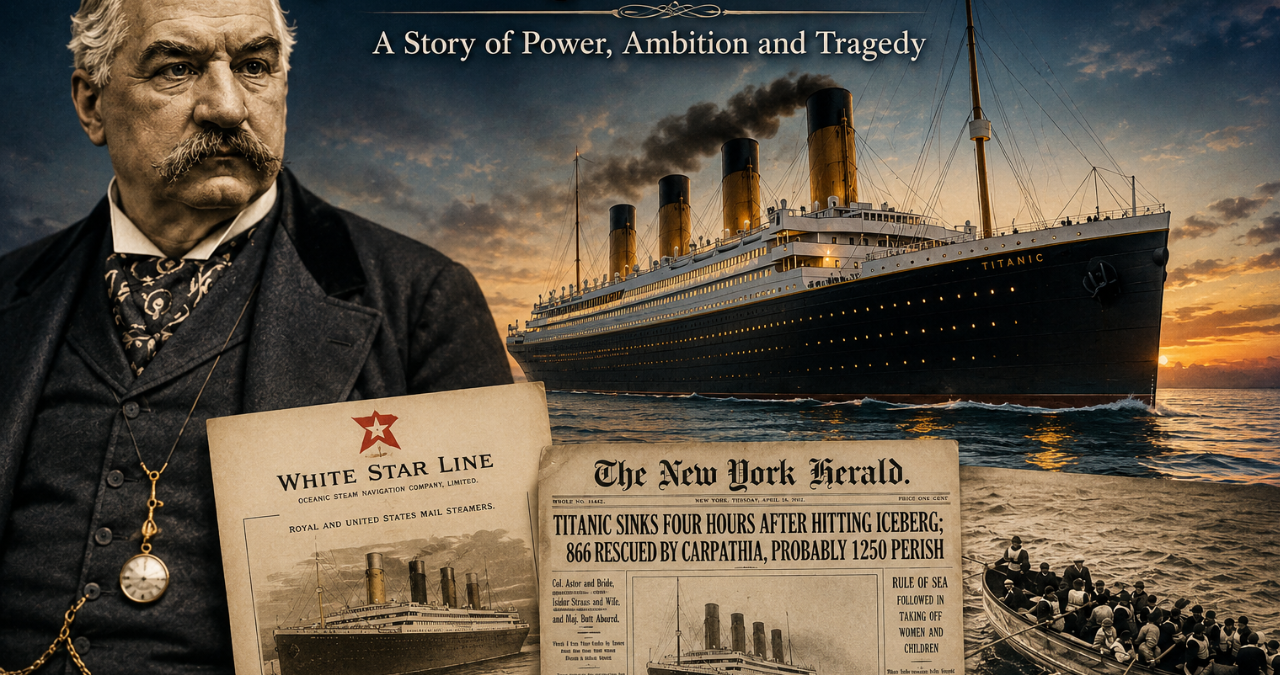
Introduction to J.P. Morgan Titanic
J.P. Morgan Titanic is a search topic that connects one of the most famous financiers in American history with one of the most famous ships ever built. John Pierpont Morgan, better known as J.P. Morgan, was a powerful banker and businessman in the late 19th and early 20th centuries. The RMS Titanic, meanwhile, was a British luxury ocean liner that became famous after sinking in the North Atlantic on April 15, 1912.
The connection between Morgan and Titanic is real, but it has often been surrounded by rumors and conspiracy theories. Morgan did not personally own Titanic in the simple sense that a person owns a private yacht or house. Instead, Titanic belonged to the White Star Line, a major British shipping company that was controlled by the International Mercantile Marine Company, a shipping organization associated with Morgan’s business empire.
One of the most interesting facts is that Morgan had originally planned to travel on Titanic’s maiden voyage. He changed his plans and did not board the ship. This detail later became the foundation for several dramatic theories claiming that Morgan knew about the disaster or even planned it. However, historical evidence does not support those claims.
Understanding the story requires separating documented history from speculation. When we do that, the connection between J.P. Morgan and Titanic becomes fascinating enough without adding unsupported myths.
Who Was J.P. Morgan?
John Pierpont Morgan was born in 1837 and became one of the most influential American financiers of his generation. His career covered banking, railroads, industrial companies, and international business.
Morgan lived during a period when the United States was changing rapidly. Large industries were growing, railroads were expanding, and enormous amounts of capital were needed to finance new businesses.
Morgan became especially well known for reorganizing companies and bringing competing businesses together. His influence became so large that he was sometimes described as a financial titan.
Some important areas connected with Morgan included:
- Banking and finance
- Railroad companies
- Industrial corporations
- Shipping businesses
- Corporate reorganizations
- International investment
- Large-scale business mergers
Morgan’s business activities were not limited to the United States. His financial network reached into Europe and other parts of the world.
His connection to Titanic came through the shipping industry rather than through direct personal ownership of the ship.
How J.P. Morgan Was Connected to Titanic
The simplest way to understand the relationship is to look at the companies involved.
Titanic was operated by the White Star Line, a British shipping company famous for its large passenger liners. White Star became part of the International Mercantile Marine Company, commonly called IMM.
IMM was a major American-controlled shipping organization associated with J.P. Morgan. Morgan had played a major role in creating and financing the organization.
This means that the connection can be understood as follows:
| Person or Company | Connection to Titanic |
|---|---|
| J.P. Morgan | Major financier connected with IMM |
| International Mercantile Marine | Controlled White Star Line |
| White Star Line | Operator of Titanic |
| Harland and Wolff | Built Titanic in Belfast |
| J. Bruce Ismay | Senior White Star executive and Titanic passenger |
| Thomas Andrews | Titanic’s chief designer |
| RMS Titanic | White Star Line ocean liner |
So, when people search for J.P. Morgan Titanic, they’re usually asking why a famous American banker was connected to the ship.
The answer is primarily financial and corporate. Morgan’s shipping interests placed him close to the company behind Titanic, but that doesn’t mean he personally directed every decision concerning the ship.
The Building of the Titanic
Titanic was part of the Olympic class of ocean liners. White Star Line wanted to compete with other major transatlantic shipping companies by offering enormous ships with impressive comfort, style, and service.
The ship was constructed by Harland and Wolff in Belfast, Ireland, beginning in 1909. Construction required thousands of workers and continued for several years. Titanic was approximately 882 feet long and represented some of the most ambitious shipbuilding of its era.
The ship was designed to attract passengers from different social classes.
It offered:
- First-class luxury
- Second-class accommodation
- Third-class cabins
- Restaurants and dining rooms
- Large public spaces
- Swimming facilities
- Exercise areas
- Electrical systems
- Elegant staircases
- Passenger lounges
- Modern communications equipment
At the time, Titanic was an extraordinary achievement.
Its size was one of its biggest attractions. Yet history would eventually show that size, wealth, and advanced technology could not guarantee safety.
Why Was Titanic So Important to J.P. Morgan’s Business World?
The early 1900s were an age of intense competition between shipping companies.
Transatlantic travel was commercially important because millions of people were crossing the Atlantic for business, immigration, tourism, and family reasons.
Companies wanted ships that could:
- Carry large numbers of passengers
- Provide comfortable accommodations
- Build strong brand reputations
- Attract wealthy travelers
- Generate reliable income
- Compete with rival shipping lines
White Star Line’s Olympic-class ships were part of this strategy.
Titanic was not simply a giant vessel. It was also a commercial symbol. It represented confidence in modern engineering and the growing importance of international travel.
For Morgan and other investors, shipping was another part of a much larger international business network.
J.P. Morgan Planned to Travel on Titanic
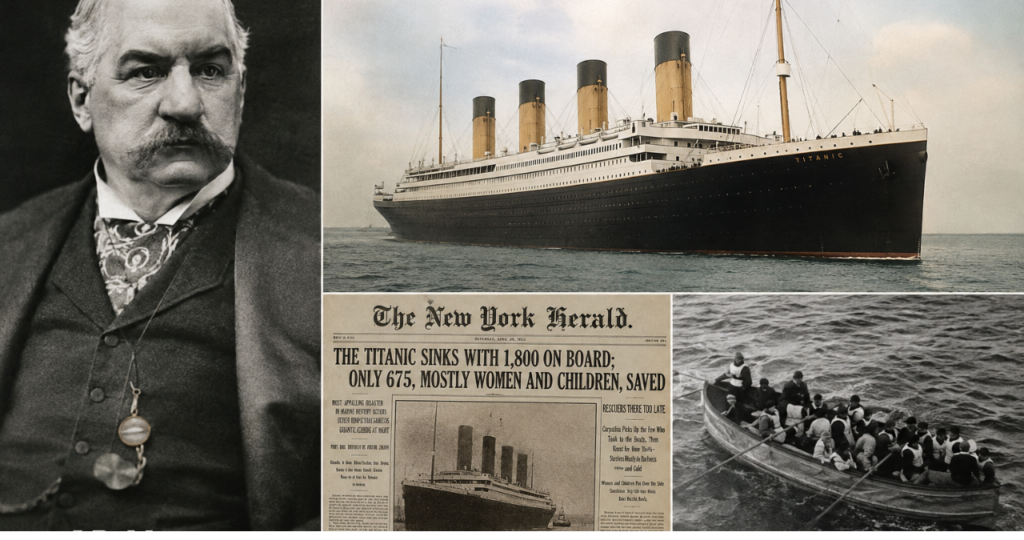
J.P. Morgan Titanic One of the strongest documented connections between Morgan and Titanic is that he had planned to travel aboard the ship.
J.P. Morgan was expected to sail on Titanic’s maiden voyage to New York. He had even been associated with arrangements for the journey.
However, Morgan canceled his trip shortly before Titanic departed. Historical accounts state that business matters and other circumstances affected his plans. He remained in Europe rather than joining the voyage.
This seemingly ordinary change of travel plans became enormously significant after Titanic sank.
Imagine the situation: a powerful businessman was connected to the company behind the ship, planned to sail aboard it, and then decided not to go. After the disaster, that coincidence naturally attracted attention.
Over time, however, the fact became much more dramatic in popular stories than the available evidence supports.
What Happened to Titanic?
Titanic left Southampton on April 10, 1912, beginning its maiden voyage to New York.
The ship also stopped at Cherbourg in France and Queenstown, now known as Cobh, in Ireland. It then continued westward across the Atlantic.
There were approximately 2,240 people aboard, including passengers and crew. Many were immigrants traveling to a new life, while others were wealthy travelers enjoying a luxury voyage.
During the night of April 14, Titanic encountered an iceberg.
At approximately 11:40 p.m., lookouts spotted the iceberg ahead. The crew attempted to avoid it, but the ship struck the iceberg.
The collision damaged the hull below the waterline.
Water began entering several compartments. Titanic’s designers had created a system of watertight compartments, but the damage was too extensive. Water eventually moved from one compartment to another as the ship’s bow sank lower.
Titanic finally disappeared beneath the Atlantic in the early morning hours of April 15.
More than 1,500 people died.
Only around 700 people survived.
The disaster shocked the world.
Why Did Titanic Sink?
The Titanic disaster wasn’t caused by one simple mistake. Instead, several factors came together.
The Iceberg
The immediate cause was the collision with an iceberg.
Titanic was traveling through an area where ice had been reported. Several ships had sent warnings about ice conditions. Some warnings were not treated with the urgency that modern safety standards would expect.
Speed
Titanic was traveling at a high speed for conditions in which ice had been reported.
The official investigations later examined the ship’s speed, navigation, warnings, and crew decisions.
Lifeboat Capacity
Titanic carried 20 lifeboats.
Although this was more than the legal minimum required at the time, the boats could not accommodate everyone aboard. This became one of the most important lessons from the tragedy.
Evacuation Problems
The lifeboats were not always filled to capacity. Confusion, fear, communication difficulties, and differences in access contributed to the loss of life.
Third-class passengers were particularly affected by the difficulties of evacuation. Historical evidence shows that survival rates differed greatly between passenger classes.
J.P. Morgan Titanic Conspiracy Theories
This is where the subject becomes especially controversial.
One popular conspiracy theory claims that J.P. Morgan deliberately arranged Titanic’s disaster to eliminate wealthy rivals such as John Jacob Astor IV, Isidor Straus, and Benjamin Guggenheim.
According to the theory, these men supposedly opposed the creation of the U.S. Federal Reserve, while Morgan wanted them removed.
The story sounds dramatic, but historical evidence does not support it.
There are several serious problems with the theory.
First, there is no reliable evidence that Morgan planned the sinking.
Second, the alleged political motive doesn’t match the historical record. History sources note that Astor and Guggenheim did not have the supposed opposition to the Federal Reserve that the theory requires, while Straus actually supported the Federal Reserve concept.
Third, the theory does not explain how Morgan could reliably arrange an iceberg collision and control the enormous number of unpredictable events that followed.
In other words, the conspiracy story is much stronger as internet folklore than as history.
Did J.P. Morgan Know Titanic Would Sink?
There is no credible historical evidence showing that J.P. Morgan knew Titanic would sink.
His cancellation of the trip is often presented as suspicious because it happened shortly before the maiden voyage.
But people change travel plans for countless reasons.
Morgan was an extremely wealthy and busy businessman. His decision not to travel can be explained without assuming secret knowledge.
Historical research must rely on documents, testimony, contemporary records, and other evidence. Coincidence alone isn’t enough to establish a conspiracy.
This is an important lesson for anyone researching J.P. Morgan Titanic: a surprising coincidence isn’t automatically proof of wrongdoing.
Did Morgan Want His Business Rivals Dead?
Another version of the theory focuses on Astor, Straus, and Guggenheim.
All three men were wealthy and influential. All three died in the Titanic disaster.
That fact makes the story sound suspicious at first glance.
However, there is no reliable evidence that Morgan selected these passengers as targets.
The three men were simply among many wealthy passengers traveling aboard Titanic.
The disaster affected people from almost every social background. Thousands of individuals had different occupations, nationalities, ages, and financial circumstances.
The Federal Reserve Connection
The Federal Reserve is often mentioned in discussions about the J.P. Morgan Titanic theory.
The Federal Reserve System was created in 1913, about a year after Titanic sank.
Conspiracy theories sometimes claim that Morgan wanted to remove opponents before the Federal Reserve was established.
But the historical record doesn’t support the idea that Titanic was deliberately used for this purpose.
The theory also oversimplifies the political and financial debates surrounding the Federal Reserve. The creation of America’s central banking system involved many people, institutions, political debates, and economic concerns.
It wasn’t simply the result of one banker making a secret decision.
Therefore, the timing of Titanic’s sinking and the Federal Reserve’s creation should not be treated as proof of a connection.
J.P. Morgan’s Death After Titanic
J.P. Morgan survived the Titanic disaster because he did not board the ship.
He died later, in 1913, at the age of 75.
His death occurred less than a year after Titanic sank.
Because of his enormous wealth and influence, Morgan remained a major figure in American finance until the end of his life.
His business legacy continued through financial institutions and corporate organizations associated with his name.
The fact that he died in 1913 sometimes appears in conspiracy discussions, but his death was not connected to Titanic. There is no reliable evidence suggesting otherwise.
The Official Investigations Into Titanic
After Titanic sank, governments on both sides of the Atlantic wanted answers.
The United States conducted a Senate investigation led by Senator William Alden Smith. Britain later conducted its own inquiry under Lord Mersey.
These investigations examined:
- Titanic’s speed
- Ice warnings
- Lifeboat arrangements
- Crew actions
- Wireless communication
- The behavior of nearby ships
- Safety regulations
- The actions of White Star Line officials
The investigations helped create a clearer understanding of the disaster.
They also produced recommendations intended to make future ocean travel safer.
Importantly, the investigations did not conclude that J.P. Morgan had secretly arranged the sinking.
That matters greatly when evaluating modern claims about the disaster.
The Role of J. Bruce Ismay
J. Bruce Ismay was another important figure in the Titanic story.
He was a senior executive of White Star Line and traveled aboard Titanic.
Unlike Morgan, Ismay survived the disaster.
Afterward, he faced intense criticism for surviving while many passengers died. He became one of the most controversial people associated with the disaster.
However, Ismay and Morgan should not be confused.
Morgan was a financier connected with IMM, while Ismay was a leading White Star executive.
Their roles were different, even though both were connected to the business structure surrounding Titanic.
Titanic and the Wealthy Passengers
Titanic carried many famous and wealthy passengers.
Among them were:
- John Jacob Astor IV
- Isidor Straus
- Ida Straus
- Benjamin Guggenheim
- Margaret Brown
- Other business leaders and prominent travelers
The presence of wealthy passengers helped make Titanic famous even before the disaster.
However, the majority of the people aboard were not billionaires or famous industrialists. Many were ordinary workers, families, immigrants, servants, and crew members.
This is important because popular stories sometimes focus heavily on the rich passengers while overlooking the many ordinary people who suffered.
The Titanic tragedy was a human disaster, not simply a story about wealthy businessmen.
What Happened to the Titanic Survivors?
After Titanic sank, survivors were rescued by the RMS Carpathia.
Carpathia brought survivors to New York, where enormous crowds waited for news.
The emotional impact was tremendous.
Families had traveled to New York expecting to welcome relatives arriving aboard Titanic. Instead, they waited for survivors from one of the worst maritime disasters in modern history.
The disaster also created an enormous demand for information.
Newspapers published stories around the world. Some early reports contained incorrect information because accurate communication was difficult immediately after the sinking.
Later investigations helped establish the facts more clearly.
How Titanic Changed Maritime Safety
Perhaps the most important legacy of Titanic is not its luxury or the conspiracy theories surrounding it.
It’s the safety lessons.
The disaster encouraged major changes in maritime regulations and practices.
Important lessons included:
- Ships needed enough lifeboat space for everyone.
- Ice warnings needed greater attention.
- Wireless communication needed stronger procedures.
- Ships required better emergency planning.
- Crews needed more effective lifeboat training.
- Continuous radio watches became increasingly important.
- International maritime safety standards needed improvement.
The Titanic disaster showed that technology without proper preparation isn’t enough.
That lesson remains relevant today.
Titanic’s Sister Ships
Titanic was one of three Olympic-class ships.
The other two were:
| Ship | Important Fact |
|---|---|
| Olympic | Titanic’s older sister ship |
| Titanic | Sank in 1912 |
| Britannic | Later served as a hospital ship during World War I |
The Titanic disaster led to design changes for Britannic. The ship was modified to improve safety, including changes related to watertight protection and lifeboat capacity.
Britannic itself later sank in the Aegean Sea in 1916 after striking a mine, although far more people survived that disaster than Titanic.
The comparison shows how lessons from one maritime tragedy could influence later ship design.
Common Myths About J.P. Morgan Titanic
Many stories about Morgan and Titanic are repeated online. Let’s examine several of them.
Myth: Morgan Owned Titanic Personally
Reality: Titanic was operated by White Star Line, which was part of the International Mercantile Marine structure associated with Morgan. This was a corporate relationship, not personal ownership in the ordinary sense.
Myth: Morgan Planned the Sinking
Reality: There is no reliable historical evidence proving this.
Myth: Morgan Knew About the Iceberg
Reality: There is no credible evidence that he possessed secret information about Titanic’s fate.
Myth: Morgan Wanted Astor, Straus, and Guggenheim Killed
Reality: This is a conspiracy theory unsupported by reliable historical evidence.
Myth: Titanic’s Sinking Was Connected to the Federal Reserve
Reality: The theory depends on unsupported claims about Morgan’s motives and the political positions of the men who died.
Why Do Titanic Conspiracy Theories Remain Popular?
People naturally search for explanations when a tragedy seems too strange to be accidental.
Titanic provides many ingredients for a conspiracy story:
- A famous billionaire banker
- A giant ship
- Several wealthy passengers
- A sudden change in Morgan’s travel plans
- A massive maritime disaster
- The later creation of the Federal Reserve
- The deaths of several powerful men
- Missing or incomplete information in the early hours after the disaster
Put these facts together, and it’s easy to see why people create dramatic theories.
But historical research requires a higher standard.
A good historian asks:
What can we prove?
Not merely:
What sounds possible?
That’s the key difference between history and speculation.
A Simple Timeline of J.P. Morgan and Titanic
| Date | Event |
|---|---|
| 1837 | J.P. Morgan was born |
| 1900s | Morgan became a major force in American finance |
| 1909 | Construction of Titanic began |
| 1911 | Titanic was launched |
| April 10, 1912 | Titanic began its maiden voyage |
| April 14, 1912 | Titanic struck an iceberg |
| April 15, 1912 | Titanic sank |
| April 1912 | Investigations began soon after the disaster |
| 1913 | Federal Reserve System was established |
| 1913 | J.P. Morgan died |
This timeline shows why some conspiracy theories focus on the years 1912 and 1913. Nevertheless, chronological proximity doesn’t establish causation.
What Makes the J.P. Morgan Titanic Story Interesting?
The genuine history is already fascinating.
J.P. Morgan was one of the most powerful financiers of his era.
Titanic was one of the most ambitious ships of its time.
White Star Line was part of a large international shipping organization connected with Morgan’s financial interests.
Morgan planned to travel on Titanic but canceled.
Titanic then sank on its maiden voyage.
Those facts alone create a remarkable historical story.
There’s no need to add unsupported claims to make it interesting.
Lessons We Can Learn From the Titanic Story
The Titanic disaster offers several broader lessons.
Wealth Cannot Guarantee Safety
Titanic carried some of the wealthiest people of its generation, but money could not protect them from the dangers of the sea.
Technology Has Limits
Titanic was considered an engineering marvel, yet engineering must always be combined with careful risk management.
Preparation Matters
Emergency planning can save lives.
Rules Matter
The disaster helped demonstrate why safety regulations must evolve as technology and transportation systems change.
Evidence Matters
The Morgan conspiracy theories also teach an important research lesson: dramatic claims need strong evidence.
When studying history, it’s better to check reliable records than to accept every viral story.
Why the J.P. Morgan Titanic Story Still Matters Today
More than a century later, Titanic remains one of the world’s best-known historical disasters.
People continue to study the ship because it represents many themes at once:
- Engineering ambition
- Social class
- Immigration
- Business competition
- Human courage
- Emergency response
- Maritime safety
- Historical memory
- The limits of technology
The involvement of Morgan’s financial network adds another layer to the story.
It helps us understand how shipping, banking, international trade, and industrial capitalism were connected during the early 20th century.
The story also reminds us that history can become distorted over time. Facts may be mixed with rumors until the two are difficult to separate.
Frequently Asked Questions About J.P. Morgan Titanic
Did J.P. Morgan own Titanic?
Not personally. Titanic was a White Star Line ship, and White Star was controlled through the International Mercantile Marine structure associated with Morgan’s financial interests.
Was J.P. Morgan supposed to be on Titanic?
Yes. Historical accounts state that Morgan had planned to travel on Titanic but canceled his trip before the ship departed.
Why didn’t J.P. Morgan travel on Titanic?
Historical accounts indicate that he canceled his plans because of circumstances involving his business and personal schedule. There is no reliable evidence that he canceled because he knew the ship would sink.
Did J.P. Morgan cause the Titanic disaster?
There is no credible historical evidence that he caused or planned the sinking.
Did Titanic really sink?
Yes. Titanic sank in the North Atlantic after striking an iceberg on April 14–15, 1912. More than 1,500 people died.
Was Titanic replaced by Olympic?
No. The idea that Titanic and Olympic were secretly switched is a well-known conspiracy theory, but historical evidence does not support it.
Was the Federal Reserve responsible for Titanic?
No credible historical evidence demonstrates such a connection. The Federal Reserve was established in 1913, after the Titanic disaster, but the timing alone doesn’t establish a relationship.
Why is J.P. Morgan mentioned so often in Titanic stories?
Morgan was associated with the corporate organization that controlled White Star Line, and he had originally planned to travel on Titanic. Those real facts became the foundation for later speculation.
Final Thoughts on J.P. Morgan Titanic
J.P. Morgan Titanic is a fascinating historical topic because it brings together banking, international shipping, engineering, wealth, tragedy, and popular conspiracy theories. The documented facts are compelling: Morgan was a powerful financier connected with International Mercantile Marine, the organization that controlled White Star Line; Titanic was one of White Star’s great ocean liners; and Morgan had planned to travel on the ship before canceling his trip.
After Titanic sank, Morgan’s decision not to travel became the subject of rumors. Some modern theories claim he deliberately arranged the disaster to eliminate wealthy rivals or influence the creation of the Federal Reserve. However, those claims aren’t supported by reliable historical evidence.
The strongest approach is to separate documented history from speculation. Titanic sank because of a combination of factors involving ice, navigation, speed, ship design, emergency preparedness, and inadequate lifeboat capacity—not because historians have discovered evidence of a secret Morgan plot. The official investigations examined the disaster in considerable detail and helped lead to important improvements in maritime safety.
Ultimately, J.P. Morgan Titanic remains an intriguing subject because the truth is already remarkable. A powerful financier was connected to the company behind the world’s most famous ocean liner, planned to sail aboard it, and then changed his plans shortly before the ship’s historic voyage. More than a century later, the story continues to remind us that history should be approached with curiosity, careful research, and respect for evidence.