
Easter traditions around the world show how one important celebration can take many different forms. Easter is a major Christian festival that celebrates the resurrection of Jesus Christ. For Christians, it is a season of faith, hope, renewal, and joy. Yet the way people observe Easter can be very different from one country, region, or family to another.
Some communities attend church services and take part in quiet prayers. Others fill their homes with flowers, prepare special meals, organize processions, or give children chocolate eggs. In some places, Easter is connected with ancient spring customs, while in others, local history and culture have created unique celebrations.
From colorful parades in Europe to special foods in Latin America and egg-related customs in many countries, Easter offers a fascinating look at human culture. Although traditions vary, many share common ideas such as new life, family, generosity, community, and hope.
Understanding easter traditions around the world is more than learning about holidays. It is a chance to discover how people preserve their history and express their beliefs through food, music, clothing, art, and community gatherings.
Why Easter Is Important to Christians
Easter is the central celebration of the Christian faith. It follows Holy Week, which remembers important events leading to the crucifixion and resurrection of Jesus.
The Easter season usually includes several important days:
- Palm Sunday: Remembers Jesus’ arrival in Jerusalem.
- Maundy Thursday: Remembers the Last Supper.
- Good Friday: Commemorates the crucifixion of Jesus.
- Holy Saturday: Marks a quiet period of waiting and reflection.
- Easter Sunday: Celebrates the resurrection of Jesus.
- Easter Monday: Observed as a public holiday or day of celebration in many countries.
The exact customs differ, but Easter Sunday is generally a joyful occasion. Churches may be decorated with flowers, hymns are sung, families gather together, and people share meals.
For many Christians, Easter represents the triumph of life and hope over death and sorrow. That message helps explain why the holiday has remained meaningful for centuries.
Easter Traditions Around the World in Europe
Europe is home to many old and fascinating Easter customs. Since Christianity has a long history on the continent, Easter celebrations often combine religious practices with local traditions.
In countries such as Spain, Italy, Greece, Poland, Germany, Sweden, and the United Kingdom, Easter may include church services, processions, traditional foods, decorated eggs, family gatherings, and community festivals.
Spain’s Holy Week Processions
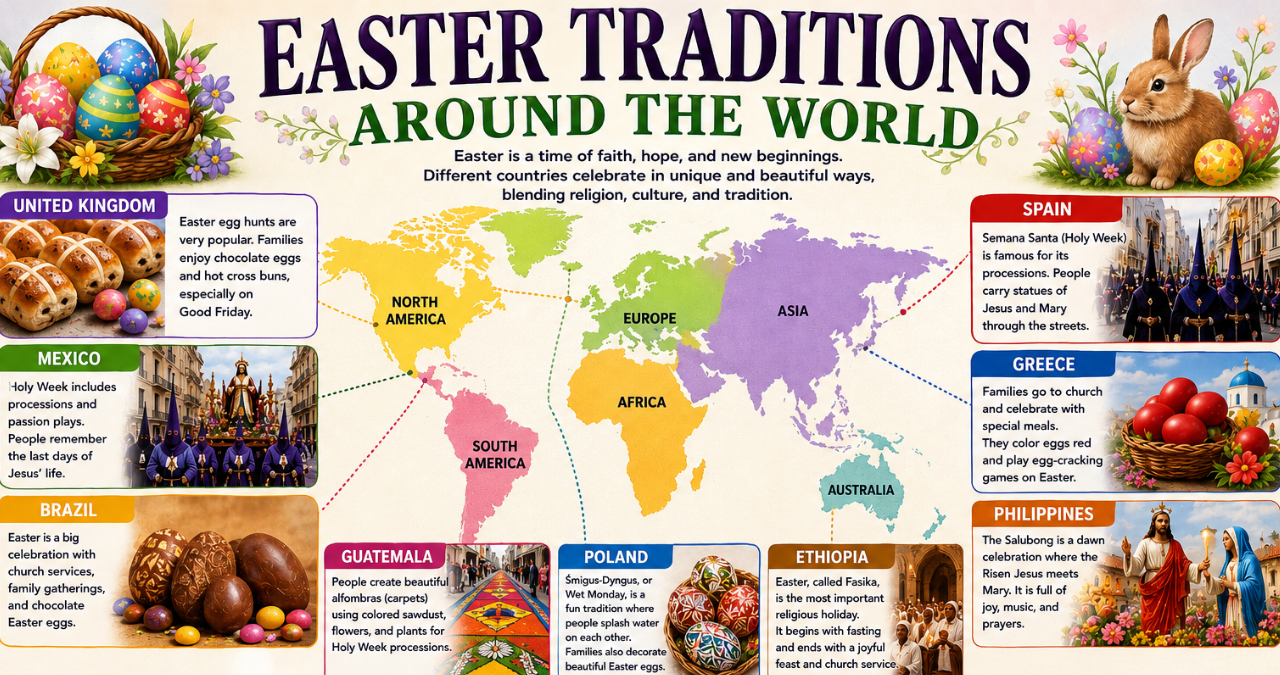
Spain is famous for its dramatic Semana Santa, or Holy Week, celebrations. Large processions take place in many cities and towns.
Participants may walk through streets carrying large religious statues. Some wear traditional clothing, while bands play solemn music. The atmosphere can be serious and reflective, especially during the days leading up to Easter Sunday.
Cities such as Seville are particularly well known for their Holy Week traditions. These events attract local residents and visitors from many parts of the world.
At the same time, Easter Sunday brings a more joyful mood. Families often enjoy special meals and spend time together.
Italy and Religious Processions
Italy has strong Easter traditions connected to the country’s Christian heritage. Religious services take place throughout Holy Week, with special ceremonies in churches and towns.
Rome becomes an important center of Easter observance. Large religious gatherings attract people from around the world.
Italian families also enjoy traditional Easter foods. One famous example is Colomba Pasquale, a sweet, dove-shaped bread often made with almonds and candied fruit.
Another popular food is pastiera, a traditional Easter dessert associated especially with Naples. Food, family, and religion come together during the holiday, creating a warm and meaningful celebration.
Greece and Red Easter Eggs
Greek Easter, known as Pascha, follows the Eastern Orthodox Christian calendar and can sometimes fall on a different date from Western Easter.
One of the most recognizable Greek customs is decorating eggs red. The color is strongly connected with the story and symbolism of Easter.
Families often attend church services during Holy Week. On Easter Sunday, large family meals may include roasted lamb, bread, salads, and other traditional dishes.
A popular activity is the egg-cracking game, in which people tap their red eggs against one another. The person whose egg remains unbroken is considered lucky.
Poland’s Śmigus-Dyngus
Poland has a playful Easter Monday tradition called Śmigus-Dyngus, sometimes known as Wet Monday.
People traditionally splash water on friends and family members. While the custom has historical roots, today it can be a fun social activity, particularly among young people.
Polish Easter also includes beautifully decorated eggs called pisanki. Families prepare special foods and may take baskets of food to church for blessing.
This combination of religious observance, artistic decoration, food, and playful customs makes Polish Easter especially distinctive.
Easter Traditions in the United Kingdom
Easter traditions around the world The United Kingdom has a mixture of Christian and folk Easter customs.
Church attendance remains important for many Christians, while other families focus on Easter meals, chocolate eggs, and community activities.
Easter Eggs
Decorated eggs have become one of the most recognizable Easter symbols. The egg can represent new life, making it a natural symbol for a festival centered on resurrection and renewal.
Today, chocolate Easter eggs are especially popular. Children may receive them as gifts or search for hidden eggs during Easter egg hunts.
Hot Cross Buns
Hot cross buns are another famous British Easter food. These sweet, spiced buns traditionally contain dried fruit and have a cross marked on top.
They are commonly associated with Good Friday and have become a familiar part of Easter food culture.
Easter Egg Hunts
Easter egg hunts are popular with children. Adults hide chocolate or decorated eggs, and children search for them.
It’s a simple activity, but it brings families and communities together. Schools, parks, churches, and community organizations may also organize egg hunts.
Easter Traditions Around the World in Latin America
Latin American countries have some of the most colorful and emotional Easter celebrations. Catholic traditions are especially influential in many communities.
Holy Week processions, religious dramas, church services, music, and family meals are common.
Guatemala’s Beautiful Alfombras
Guatemala is known for elaborate alfombras, or carpets, created during Holy Week.
People make these temporary artworks from colored sawdust, flowers, plants, and other materials. They can feature detailed religious designs and bright patterns.
The carpets are often placed along streets where religious processions will pass. Although the artwork may take many hours to create, it is temporary because the procession moves across it.
This tradition demonstrates how art can become part of religious expression.
Mexico’s Passion Plays and Processions
Mexico has many Holy Week traditions. In some communities, people organize dramatic performances that represent events from the final days of Jesus’ life.
Processions may move through streets while participants carry religious images. Churches become important gathering places for prayer and reflection.
Food also plays a major role. Families prepare traditional dishes, although exact recipes vary greatly between regions.
Brazil’s Easter Celebrations
Brazil is known for its strong Christian traditions and large public celebrations. During Holy Week, some communities organize processions and church services.
Easter also has a strong commercial side, especially through chocolate eggs. Large chocolate Easter eggs are popular gifts, and children often look forward to receiving them.
Despite modern influences, the religious meaning of Easter remains important for many Brazilian families.
Easter Traditions in Africa
Africa is home to many Christian communities, and Easter celebrations can be both religious and deeply social.
In countries such as Ethiopia, Kenya, Ghana, Nigeria, and South Africa, Easter customs differ according to local cultures and Christian traditions.
Ethiopia’s Easter Celebration
Ethiopian Orthodox Christians celebrate Easter, known as Fasika, according to the Ethiopian Orthodox calendar.
The celebration follows a period of fasting and religious preparation. Church services can continue for long periods, and families gather afterward for meals.
Traditional foods may include dishes made with meat, bread, vegetables, and spices. The end of the fasting period makes the Easter meal especially meaningful.
Easter in South Africa
South African Easter traditions can include church services, family gatherings, religious music, and community events.
Many Christians travel to visit relatives during the Easter holiday. Churches may hold special services, and families often share meals together.
For some people, Easter is also a time to think about helping others and strengthening relationships.
Easter Traditions in Asia
Although Christianity is a minority religion in many Asian countries, several nations have important Easter celebrations.
The Philippines has one of Asia’s most visible Easter traditions because of its large Christian population.
The Philippines and Salubong
In the Philippines, Salubong is a traditional Easter dawn ceremony.
The event symbolically brings representations of the risen Jesus and Mary together. It may include processions, music, prayers, and community participation.
The celebration can be especially emotional and joyful because it represents the end of Holy Week and the beginning of Easter Sunday.
Families may then attend church services and enjoy a special meal together.
Easter in India
India has Christian communities with their own Easter customs. Celebrations vary from region to region.
Church services, prayers, hymns, processions, and family meals are common. In places with large Christian populations, Easter can be an important community event.
Special foods may include cakes, breads, rice dishes, curries, and regional specialties.
India’s cultural diversity means that there is no single Easter style. Instead, traditions reflect local languages, foods, music, and customs.
Easter Traditions in Australia and New Zealand
Australia and New Zealand have developed their own Easter customs while maintaining many European Christian traditions.
Church services and family gatherings remain important for Christians. Easter egg hunts are also popular with children.
One interesting Australian connection is the bilby, a native Australian animal. Because rabbits are considered an introduced pest in Australia, some conservation campaigns have promoted the Easter Bilby as an alternative to the traditional Easter Bunny.
This idea connects Easter with environmental awareness and native wildlife protection.
In New Zealand, Easter includes church services, family gatherings, chocolate eggs, and holiday activities. Many people also use the long weekend for travel or outdoor activities.
Easter Food Traditions Around the World
Food is one of the easiest ways to understand cultural traditions. Easter meals can be very different from one country to another.
| Country or Region | Traditional Easter Food or Custom | Cultural Meaning |
|---|---|---|
| United Kingdom | Hot cross buns | Linked with Good Friday |
| Italy | Colomba Pasquale | Traditional Easter sweet bread |
| Greece | Red eggs and roasted lamb | Family and Orthodox Easter traditions |
| Poland | Pisanki and blessed food | Religious and cultural heritage |
| Mexico | Regional Holy Week dishes | Family and religious traditions |
| Ethiopia | Fasika feast | Celebration after fasting |
| Spain | Traditional Easter foods | Connected with Holy Week |
| Brazil | Chocolate Easter eggs | Family celebration and gift giving |
| Australia | Chocolate eggs and Easter Bilby | Modern Easter and local wildlife awareness |
| Philippines | Easter feast | Community and religious celebration |
Food isn’t simply something placed on the table. It can carry memories from one generation to the next. Recipes are often taught by parents and grandparents, helping families preserve their cultural identity.
The Meaning Behind Easter Eggs
Easter eggs are found in many countries, but their history is more complex than a simple children’s game.
Eggs have long been associated with new life. Since Easter celebrates resurrection, the egg became a meaningful symbol in Christian cultures.
Over time, different communities developed their own egg customs.
Some people:
- Paint eggs by hand.
- Decorate eggs with traditional patterns.
- Hide eggs for children to find.
- Exchange chocolate eggs.
- Use eggs in family games.
- Display decorated eggs as seasonal decorations.
In Eastern European countries, egg decorating can become a detailed art form. Traditional designs may contain symbols and patterns that have been passed down for generations.
The Easter Bunny and Other Modern Symbols
The Easter Bunny is particularly popular in countries influenced by European and North American traditions.
The rabbit is associated with fertility and spring because rabbits are known for producing many offspring. Over time, this springtime symbolism became connected with Easter.
Today, the Easter Bunny is mainly a children’s character. It appears on greeting cards, decorations, chocolates, toys, and advertisements.
Not every country uses the Easter Bunny. In fact, some cultures have completely different Easter symbols.
This is a useful reminder that traditions aren’t fixed. They change as communities interact, travel, and adopt new ideas.
Easter Parades, Music, and Community Events
Easter isn’t only about private family gatherings. In many places, it is a public celebration.
Parades may include:
- Religious groups
- Musical bands
- Traditional costumes
- Religious statues
- Flowers
- Decorated vehicles
- Community organizations
Music can also play an important role. Churches may sing special hymns, while outdoor processions may include bands or traditional instruments.
These public events help bring people together. Even people who don’t participate in every religious activity may appreciate the cultural and artistic aspects of Easter.
How Easter Traditions Have Changed Over Time
Traditions naturally change. What people practiced hundreds of years ago isn’t always the same as what families do today.
Modern technology, travel, media, and global business have influenced Easter celebrations.
For example, chocolate eggs are now sold in many countries. Social media allows people to share Easter meals, decorations, and celebrations with friends around the world.
At the same time, many families work hard to preserve older traditions.
Grandparents may teach children how to decorate eggs. Churches may continue centuries-old processions. Families may prepare recipes that have been passed down for generations.
The result is an interesting blend of old and new.
Similarities Among Easter Traditions Around the World
Despite their differences, many Easter celebrations share common themes.
Faith
For Christians, Easter is fundamentally a religious celebration connected with the resurrection of Jesus.
Family
Easter often brings relatives together for meals, church services, or special activities.
New Life
Eggs, flowers, springtime, and other symbols frequently represent renewal and new beginnings.
Community
Processions, festivals, church events, and public celebrations create opportunities for people to gather.
Generosity
Giving chocolate, food, gifts, or assistance to others is part of Easter culture in many communities.
These shared themes help explain why Easter can feel familiar even when the traditions look completely different.
Respecting Different Easter Traditions
Learning about global traditions requires respect. No single Easter custom should be treated as the “correct” way to celebrate.
Different communities have their own histories and beliefs. Some traditions are religious, while others are cultural or family-based.
When exploring Easter customs, it’s helpful to:
- Learn from reliable historical sources.
- Avoid stereotypes.
- Understand that practices vary within countries.
- Respect religious beliefs.
- Remember that traditions can change over time.
- Appreciate both similarities and differences.
A thoughtful approach turns cultural learning into an opportunity for understanding.
Easter Traditions Around the World: What We Can Learn
Easter traditions around the world teach us that celebrations can connect people across generations and borders.
A red egg in Greece, an elaborate carpet in Guatemala, a procession in Spain, a sweet bread in Italy, a water-filled celebration in Poland, or an Easter dawn ceremony in the Philippines may look completely different. Yet each can express a sense of community, faith, history, and hope.
These customs also show the importance of preserving cultural heritage. In a rapidly changing world, traditional celebrations give families a chance to remember where they came from.
At the same time, Easter demonstrates that traditions can evolve. New foods, environmental ideas, technology, and modern family lifestyles continue to influence how people celebrate.
Tips for Learning About Easter Cultures
If you’re interested in discovering Easter traditions from other countries, there are several easy ways to begin.
- Read books about world cultures and religious history.
- Visit cultural museums and exhibitions.
- Watch documentaries from trusted sources.
- Learn traditional Easter recipes.
- Talk with people from different cultural backgrounds.
- Explore the history behind Easter symbols.
- Attend public cultural events respectfully.
- Learn about the difference between religious and commercial customs.
The goal isn’t to copy another culture. Instead, it is to understand and appreciate it.
Conclusion: The Shared Spirit of Easter
Easter traditions around the world reveal a remarkable mixture of faith, history, food, art, family, and community. From solemn processions to cheerful egg hunts, every tradition tells a story about the people who practice it.
While Easter celebrations vary widely, many are connected by powerful ideas: hope, renewal, love, family, generosity, and new beginnings. These values give the holiday meaning beyond decorations and gifts.
Perhaps that’s what makes Easter so fascinating. One celebration can take hundreds of different forms, yet still bring people together around shared feelings of hope and joy.
By exploring easter traditions around the world, we gain more than knowledge about a holiday. We gain a better understanding of the diverse ways people celebrate life, preserve their heritage, strengthen their communities, and pass meaningful traditions from one generation to the next. In the end, easter traditions around the world remind us that cultural differences can be beautiful—and that shared hope can bring people closer together.