
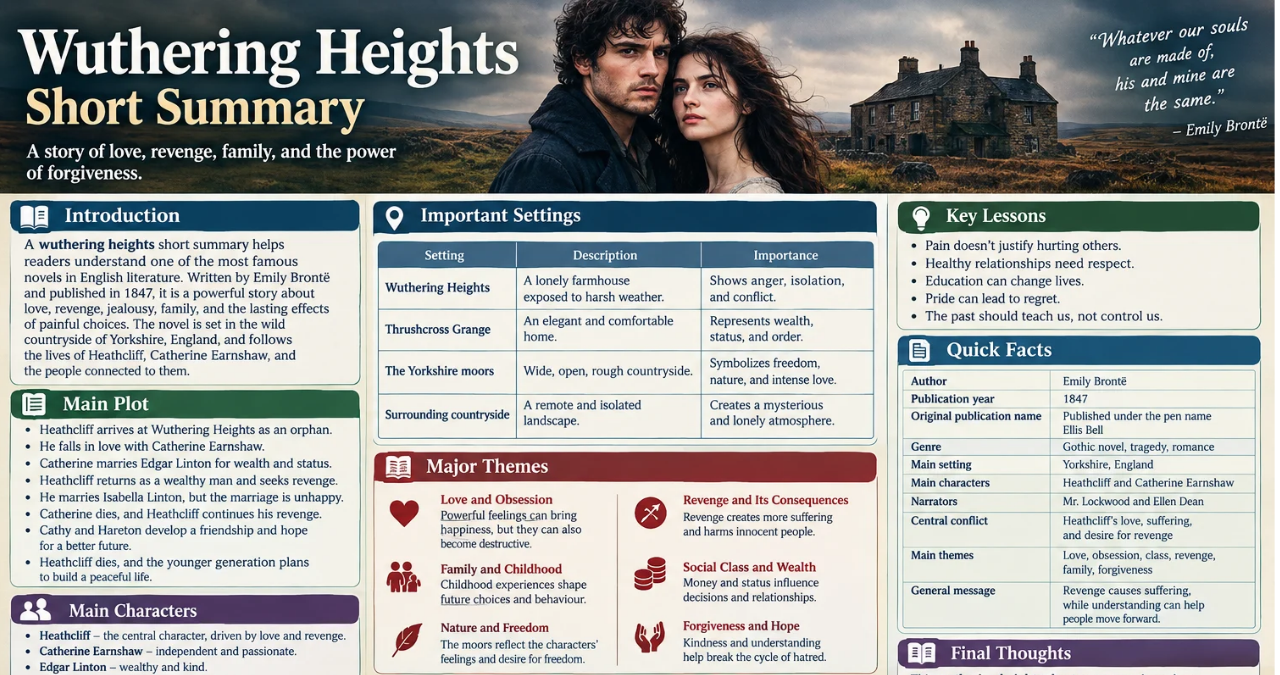
A wuthering heights short summary helps readers understand one of the most famous novels in English literature. Written by Emily Brontë and published in 1847, Wuthering Heights is a powerful story about love, revenge, jealousy, family, and the lasting effects of painful choices. Although the novel is often described as a love story, it is much more than that. It explores how strong emotions can bring people together, tear families apart, and influence future generations.
The story takes place in the wild countryside of Yorkshire, England. Its two main locations are Wuthering Heights, a lonely farmhouse on the moors, and Thrushcross Grange, a more comfortable and elegant home nearby. These places reflect the different personalities, lifestyles, and conflicts of the people who live in them.
At the heart of the novel are Heathcliff and Catherine Earnshaw. They share a deep and intense connection, but pride, social class, and poor decisions prevent them from finding happiness together. Their relationship creates a chain of suffering that affects several members of their families.
However, the novel isn’t only about darkness and pain. Through the younger generation, Emily Brontë also shows that kindness, understanding, and forgiveness can help people escape the mistakes of the past. This guide explains the story in simple English, making it easier for students and general readers to understand its plot, characters, themes, and meaning.
What Is Wuthering Heights About?
Wuthering Heights is a Gothic novel that combines romance, mystery, family drama, and tragedy. It follows the troubled lives of Heathcliff, Catherine Earnshaw, and the people connected to them.
The novel begins when Mr. Lockwood rents Thrushcross Grange and visits his landlord, Heathcliff, who lives at Wuthering Heights. During his visit, Lockwood experiences strange and unsettling events. Curious about the history of the household, he asks the housekeeper, Ellen Dean, to explain what happened there.
Through Ellen’s memories, readers learn about Heathcliff’s childhood, his close relationship with Catherine, and the painful events that shape his future.
Heathcliff grows up as an outsider in the Earnshaw family. Although Catherine becomes his closest companion, she eventually marries Edgar Linton, a wealthy gentleman. Heathcliff feels betrayed and spends years seeking revenge against those he believes have wronged him.
His actions harm both the older and younger generations. Yet, as the story moves toward its conclusion, the younger characters begin to break free from the cycle of hatred.
The main idea is that love can be powerful, but love mixed with pride, jealousy, and revenge can become destructive. The novel also suggests that people can choose a better future instead of repeating the mistakes of those who came before them.
Wuthering Heights Short Summary of the Main Plot
Heathcliff Arrives at Wuthering Heights
The story begins years before Lockwood visits the house. Mr. Earnshaw, the owner of Wuthering Heights, returns from Liverpool with an orphaned boy named Heathcliff. He brings the child home and raises him alongside his own children, Catherine and Hindley.
Catherine quickly becomes close to Heathcliff. They enjoy spending time together on the open moors, away from the rules and expectations of society. Their friendship grows into a powerful emotional bond.
Hindley, however, dislikes Heathcliff because he believes the newcomer receives too much attention from their father. After Mr. Earnshaw dies, Hindley takes control of the household. He treats Heathcliff cruelly and forces him to work as a servant rather than allowing him to receive an education.
Despite this unfair treatment, Heathcliff remains close to Catherine. Their connection becomes the central force behind many of the novel’s later events.
Catherine Meets Edgar Linton
One day, Catherine and Heathcliff visit Thrushcross Grange, the home of Edgar and Isabella Linton. The Lintons live a more comfortable and refined life than the people at Wuthering Heights.
During the visit, Catherine is injured and stays at Thrushcross Grange while she recovers. She becomes more familiar with the Linton family’s manners and lifestyle.
When Catherine returns home, her appearance and behaviour have changed. She still cares deeply about Heathcliff, but she has also become interested in the comfort and social position that Edgar can offer.
Edgar eventually falls in love with Catherine and asks her to marry him. Catherine accepts his proposal, believing that marriage will give her a secure and respected place in society.
However, she confides in Ellen Dean that her feelings for Heathcliff are far deeper than an ordinary friendship. She believes their identities are closely connected. Heathcliff overhears only part of this conversation and leaves before hearing Catherine explain her feelings fully.
Heathcliff feels rejected and disappears. His departure marks the beginning of a long and painful struggle for revenge.
Heathcliff Returns as a Wealthy Man
After several years, Heathcliff returns to the area. He is no longer the poor, uneducated boy who once suffered under Hindley’s control. He has gained wealth, improved his appearance, and become more confident.
His return surprises Catherine and unsettles Edgar. Although Catherine is delighted to see Heathcliff again, his personality has become darker and more determined.
Heathcliff hasn’t forgotten the humiliation he experienced during childhood. He wants to punish Hindley for treating him badly and believes Catherine’s marriage to Edgar has deprived him of the life he deserved.
Instead of moving forward, Heathcliff begins to use money, manipulation, and emotional pressure to gain control over others.
He encourages Hindley’s gambling problems and takes advantage of his financial difficulties. As Hindley falls deeper into debt, Heathcliff gains control over Wuthering Heights.
His behaviour shows how suffering can lead to bitterness when a person chooses revenge instead of healing.
Heathcliff and Isabella Linton
Heathcliff also becomes involved with Isabella Linton, Edgar’s younger sister. Isabella develops romantic feelings for him, even though he treats her with little genuine affection.
Heathcliff marries Isabella, but the marriage quickly becomes unhappy. He sees the relationship as a way to hurt Edgar and gain further control over the Linton family.
Isabella soon discovers that Heathcliff is cruel and emotionally abusive. She realizes that the man she imagined loving doesn’t truly care about her happiness.
Eventually, Isabella escapes from Heathcliff and leaves the area. She later gives birth to their son, Linton Heathcliff.
This part of the novel demonstrates the danger of confusing attraction with healthy love. A loving relationship requires respect, care, and honesty, none of which Heathcliff offers Isabella.
Catherine’s Death and Heathcliff’s Grief
Catherine’s relationship with Heathcliff becomes increasingly difficult as her marriage to Edgar continues. She is torn between her emotional connection to Heathcliff and her life with Edgar.
The tension, anger, and emotional strain damage her health. After giving birth to a daughter named Cathy, Catherine dies.
Her death becomes one of the most tragic moments in the novel. Heathcliff is devastated, but he responds to his grief in an unhealthy way. Rather than accepting the loss and finding peace, he remains obsessed with Catherine and expresses a desire to stay connected to her even after death.
Heathcliff’s grief reveals the depth of his feelings, but it also shows how obsession can prevent a person from moving forward.
Edgar is left to raise their daughter, Cathy Linton, while Heathcliff continues to live with anger and sorrow.
Heathcliff’s Revenge Against the Younger Generation
Heathcliff’s desire for revenge doesn’t end with Catherine’s death. He turns his attention toward the next generation, hoping to gain control over both family estates.
His son, Linton Heathcliff, is weak and frequently ill. Meanwhile, Edgar’s daughter, Cathy, grows up without knowing the full history of her parents’ troubled relationships.
Cathy meets Linton and becomes interested in him. Heathcliff takes advantage of this connection because he wants Cathy to marry his son. Such a marriage would help him gain control over Thrushcross Grange.
Heathcliff manipulates events and pressures Cathy into marrying Linton. After Edgar dies, Heathcliff’s plan helps him gain control over the property and secure his position.
Cathy’s marriage brings her little happiness. She suffers under Heathcliff’s authority and must learn how to survive in an unfriendly household.
Through these events, the novel shows that revenge rarely affects only the person who caused the original injury. Innocent people often suffer the greatest consequences.
Young Cathy and Hareton Begin to Change
At wuthering heights short summary Wuthering Heights, Cathy meets Hareton Earnshaw, Hindley’s son. Hareton has been denied the education and social opportunities that should have been his. Heathcliff deliberately keeps him uneducated because he wants Hareton to experience the same kind of humiliation that he once suffered.
At first, Cathy looks down on Hareton because he cannot read well and lacks refined manners. Their relationship is unfriendly, and they struggle to understand one another.
Over time, however, Cathy begins to see Hareton’s good qualities. She recognizes that he isn’t naturally cruel or unintelligent; he has simply been denied the chance to develop his abilities.
Cathy starts helping Hareton learn to read. Their shared experiences gradually create respect, friendship, and affection.
Unlike the relationship between Catherine and Heathcliff, their bond grows through patience and cooperation rather than pride and emotional conflict.
This change is important because it offers hope after years of suffering.
Heathcliff’s Final Days
As Heathcliff grows older, he becomes increasingly haunted by memories of Catherine. His desire for revenge begins to lose its purpose, especially as he watches Cathy and Hareton grow closer.
He no longer feels the same satisfaction from controlling others. His thoughts become more focused on Catherine, and he seems increasingly detached from ordinary life.
Eventually, Heathcliff dies under mysterious circumstances. After his death, people in the area report seeing strange figures on the moors, adding to the novel’s Gothic atmosphere.
The ending leaves readers with a sense of uncertainty about whether Heathcliff and Catherine have finally found peace. Their story remains tragic, but the younger generation has a chance to build a happier life.
Cathy and Hareton plan to marry and leave behind the hostility that has controlled their families for so long. Their future suggests that compassion and education can help people overcome inherited bitterness.
Main Characters in Wuthering Heights
Understanding the characters makes the plot much easier to follow. Each person contributes to the novel’s exploration of love, power, family, and revenge.
Heathcliff
Heathcliff is the central male character. He arrives at Wuthering Heights as an orphan and experiences rejection, humiliation, and cruel treatment.
His love for Catherine is intense, but his pain gradually turns into an overwhelming desire for revenge.
Important qualities include:
- Deep emotional attachment to Catherine.
- Strong determination and ambition.
- Anger caused by years of mistreatment.
- A desire to control people and property.
- Difficulty forgiving and moving beyond the past.
Heathcliff is a complex character. Readers may understand why he feels hurt, but his suffering doesn’t excuse the harm he causes to others.
Catherine Earnshaw
Catherine Earnshaw is independent, passionate, and strong-willed. She shares a powerful connection with Heathcliff, yet she chooses to marry Edgar Linton.
Her decision is influenced by social expectations, wealth, and her desire for a comfortable life. She struggles to balance these concerns with her deeper emotional feelings.
Catherine’s choices help drive the tragedy of the novel. Her story also shows how difficult it can be to make decisions when personal desires conflict with social pressure.
Edgar Linton
Edgar is a wealthy and polite gentleman who becomes Catherine’s husband. He offers her comfort, stability, and a more peaceful home.
Unlike Heathcliff, Edgar usually responds to conflict through restraint rather than revenge. However, his jealousy and inability to understand Catherine’s connection to Heathcliff contribute to the household’s tension.
Edgar represents social respectability and a calmer way of life.
Isabella Linton
Isabella is Edgar’s younger sister. She becomes attracted to Heathcliff without fully understanding his personality.
Her marriage to him teaches her a painful lesson about the difference between romantic fantasy and real affection. Eventually, she finds the courage to escape an abusive relationship.
Her story highlights the importance of self-respect and personal safety.
Hindley Earnshaw
Hindley is Catherine’s brother and Heathcliff’s childhood enemy. He treats Heathcliff cruelly after their father’s death.
His gambling and poor decisions weaken his financial position, allowing Heathcliff to gain control of Wuthering Heights.
Hindley’s behaviour begins the cycle of mistreatment that Heathcliff later repeats against others.
Cathy Linton
Cathy is the daughter of Catherine Earnshaw and Edgar Linton. She grows up with a more protected childhood than her mother experienced.
After meeting Linton Heathcliff, she becomes caught in Heathcliff’s revenge plan. Nevertheless, she eventually develops greater understanding and patience.
Her growing friendship with Hareton provides one of the novel’s strongest signs of hope.
Hareton Earnshaw
Hareton is Hindley’s son. Heathcliff raises him in an environment designed to limit his education and confidence.
Although Hareton initially appears rough and uneducated, he has the ability to learn and improve. Cathy helps him discover that potential.
His character shows how encouragement and education can change a person’s future.
Linton Heathcliff
Linton is the son of Heathcliff and Isabella. He is physically weak, emotionally dependent, and often afraid of his father.
Heathcliff uses him as part of a plan to gain control of Thrushcross Grange. Linton’s marriage to Cathy becomes an important part of this strategy.
Ellen Dean and Mr. Lockwood
Ellen Dean, often called Nelly, is the housekeeper who tells much of the story. Her memories connect the characters and events across several years.
Mr. Lockwood is the tenant at Thrushcross Grange who introduces the reader to Heathcliff and the mysterious world of Wuthering Heights.
Their roles create the novel’s unusual storytelling structure, in which the past is revealed through memories and personal accounts.
Important Settings in Wuthering Heights
The setting isn’t just a background for the story. It helps explain the characters’ feelings and the conflicts they face.
| Setting | Description | Importance |
|---|---|---|
| Wuthering Heights | A lonely farmhouse exposed to the harsh Yorkshire weather | Reflects anger, isolation, and emotional conflict |
| Thrushcross Grange | An elegant and comfortable home | Represents wealth, social status, and order |
| The Yorkshire moors | Wide, open areas of rough countryside | Suggest freedom, nature, and the intense bond between Catherine and Heathcliff |
| The surrounding countryside | A remote landscape separated from busy towns | Creates a mysterious and isolated atmosphere |
The contrast between Wuthering Heights and Thrushcross Grange is especially important. One house is associated with roughness and emotional intensity, while the other represents comfort and social expectations.
Neither setting is entirely good or bad. Instead, each reflects different parts of the characters’ lives.
Major Themes in Wuthering Heights
Love and Obsession
Love is one of the novel’s central themes, but Emily Brontë presents it in a complicated way.
Catherine and Heathcliff share a powerful connection, yet their feelings become mixed with pride, jealousy, and emotional dependence. Their relationship demonstrates that strong feelings alone don’t guarantee a healthy partnership.
By contrast, Cathy and Hareton gradually build their connection through respect and learning. Their relationship suggests that lasting affection requires kindness as well as emotion.
Revenge and Its Consequences
Heathcliff’s revenge drives much of the plot. He wants Hindley, Edgar, and their families to experience the pain he believes they caused him.
However, his actions hurt people who weren’t responsible for his childhood suffering. The younger generation becomes trapped in a conflict that began long before they were born.
The novel teaches that revenge may promise satisfaction, but it often creates more suffering instead.
Social Class and Wealth
Social class strongly influences the characters’ decisions. Catherine believes marrying Edgar will provide security and status, while Heathcliff initially suffers because others consider him inferior.
As Heathcliff becomes wealthy, he gains social power and uses it to control the people who once looked down on him.
The story questions a society in which money and family background can influence a person’s opportunities and relationships.
Family and Childhood
The novel shows how childhood experiences can affect people for many years.
Heathcliff’s mistreatment shapes his anger, while Hareton’s lack of education limits his confidence. Both characters suffer because of decisions made by older family members.
Yet Hareton’s relationship with Cathy shows that childhood disadvantages don’t have to determine a person’s entire future.
Nature and Freedom
The Yorkshire moors are closely connected to Catherine and Heathcliff’s childhood freedom. Away from the expectations of society, they can express themselves more openly.
Nature also reflects the novel’s wild and unpredictable emotions. Storms, rough winds, and lonely landscapes support the dark mood of the story.
Forgiveness and Hope
Although the novel contains cruelty and tragedy, it doesn’t end without hope.
Cathy and Hareton gradually stop judging each other and learn to work together. Their relationship breaks the pattern of hostility that has harmed both families.
Their future suggests that people can learn from the past without allowing it to control every decision.
Why Is Wuthering Heights Considered a Gothic Novel?
Gothic literature often includes mystery, dark settings, emotional extremes, supernatural suggestions, and troubled characters. Wuthering Heights contains many of these features.
The novel’s Gothic elements include:
- An isolated house surrounded by wild countryside.
- Strange dreams and unsettling nighttime experiences.
- References to ghosts and possible supernatural events.
- Family secrets and painful memories.
- Characters driven by intense emotions.
- A dark atmosphere shaped by death, loss, and revenge.
These features create suspense and make the story feel mysterious. They also support the novel’s deeper questions about memory, grief, and the connection between the living and the dead.
However, the novel is not simply a ghost story. Its lasting power comes from the way it combines Gothic mystery with realistic human struggles.
The Meaning of the Novel’s Ending
The ending of Wuthering Heights is important because it contrasts Heathcliff’s destructive behaviour with the younger generation’s growing affection.
For much of the novel, Heathcliff believes that revenge will help him overcome his suffering. Yet, as he approaches the end of his life, he seems less interested in continuing the conflict.
His emotional focus shifts toward Catherine and the possibility of being reunited with her. His death brings an end to his control over the household.
Meanwhile, Cathy and Hareton move toward marriage and a more peaceful future. They represent a chance for the two families to leave old grudges behind.
The ending can be understood in several ways:
- Emotional freedom: The younger characters begin to escape the pain created by earlier generations.
- The end of revenge: Heathcliff’s death removes the central force maintaining the family conflict.
- The power of kindness: Cathy and Hareton show that understanding can replace hostility.
- Uncertainty and mystery: Reports of spirits on the moors leave room for different interpretations.
The ending doesn’t erase the suffering of the past. Instead, it suggests that people can make better choices even after experiencing hardship.
Lessons Readers Can Learn from Wuthering Heights
Although the novel was written in the nineteenth century, many of its ideas remain relevant today.
Pain Doesn’t Justify Hurting Others
Heathcliff suffers greatly as a child, and readers can understand why he becomes angry. Nevertheless, his later actions harm innocent people.
The lesson is clear: difficult experiences may explain behaviour, but they don’t automatically excuse it.
Healthy Relationships Need Respect
Catherine and Heathcliff share intense feelings, but their relationship is filled with emotional conflict. Isabella also discovers that attraction doesn’t guarantee kindness.
In contrast, Cathy and Hareton learn to respect and support one another.
A healthy relationship needs honesty, patience, mutual respect, and care.
Education Can Change Lives
Hareton is treated as though he has little potential because he cannot read well. Cathy helps him learn, revealing abilities that others have overlooked.
This reminds readers that education can build confidence and open new opportunities.
Pride Can Lead to Regret
Several characters make decisions based on pride, social position, or the desire to prove themselves. These choices create problems that could have been avoided through honest communication.
Sometimes, admitting a mistake is far better than allowing it to grow into a lasting conflict.
The Past Should Teach Us, Not Control Us
Heathcliff spends much of his life trying to correct the wrongs of his childhood through revenge. As a result, he creates new problems rather than finding peace.
Cathy and Hareton choose a different path. They learn from their experiences and build a future based on cooperation.
The novel encourages readers to recognize the past while remaining open to change.
Wuthering Heights Short Summary for Students
For students who need a shorter explanation, the novel can be summarized in a few clear paragraphs.
Wuthering Heights by Emily Brontë tells the story of Heathcliff, an orphan who is brought to Wuthering Heights by Mr. Earnshaw. Heathcliff becomes close to Catherine Earnshaw, but her brother Hindley treats him cruelly. Catherine later marries Edgar Linton because of his wealth and social position, even though she has deep feelings for Heathcliff.
Heathcliff leaves and returns years later as a wealthy man. Filled with anger, he seeks revenge against the people who mistreated him. He marries Isabella Linton to hurt her brother Edgar and gains control over Wuthering Heights through Hindley’s financial troubles. After Catherine dies, Heathcliff continues his revenge by manipulating the younger generation.
He forces events that lead to the marriage of Cathy Linton and his son, Linton Heathcliff. After Linton’s death, Cathy remains under Heathcliff’s control. Over time, she develops a friendship with Hareton Earnshaw and helps him learn to read. Their growing affection offers hope that the families can finally escape their history of hatred.
Heathcliff eventually dies, and Cathy and Hareton plan to marry. Their relationship suggests that kindness, education, and forgiveness can help people overcome the mistakes of earlier generations.
Quick Facts About Wuthering Heights
| Fact | Information |
|---|---|
| Author | Emily Brontë |
| Publication year | 1847 |
| Original publication name | Published under the pen name Ellis Bell |
| Genre | Gothic novel, tragedy, romance |
| Main setting | Yorkshire, England |
| Main characters | Heathcliff and Catherine Earnshaw |
| Narrators | Mr. Lockwood and Ellen Dean |
| Central conflict | Heathcliff’s love, suffering, and desire for revenge |
| Main themes | Love, obsession, class, revenge, family, and forgiveness |
| General message | Revenge causes suffering, while understanding can help people move forward |
Why Wuthering Heights Remains Popular Today
Wuthering Heights continues to attract readers because it explores emotions and problems that people still recognize. Love, jealousy, family pressure, social inequality, and the desire for acceptance remain important subjects.
The novel also encourages readers to think carefully about the difference between understanding a character and approving of that character’s actions. Heathcliff is both a victim of cruelty and a person who later causes serious harm. This complexity makes him memorable.
Emily Brontë’s use of setting and storytelling adds another layer of interest. The lonely moors, the two contrasting houses, and the stories told by different narrators create a world that feels both realistic and mysterious.
Students can also appreciate the novel because its characters make choices with lasting consequences. Their experiences provide useful opportunities to discuss responsibility, forgiveness, emotional health, and the importance of learning from mistakes.
Even though the language may seem challenging to modern readers, a clear understanding of the plot and themes makes the novel much easier to enjoy.
Conclusion: Wuthering Heights Short Summary
This wuthering heights short summary explains the main events, characters, themes, and lessons of Emily Brontë’s famous novel. The story begins with Heathcliff’s arrival at Wuthering Heights and follows his powerful connection with Catherine Earnshaw. Their relationship is damaged by social expectations, personal choices, and unresolved emotions. After Catherine marries Edgar Linton and dies, Heathcliff turns his suffering into a long campaign of revenge that affects both families.
However, the novel’s final chapters introduce a more hopeful direction. Cathy Linton and Hareton Earnshaw learn to respect one another, showing that kindness and education can help people move beyond inherited hatred. Heathcliff’s death brings the central conflict to an end, while the younger characters prepare for a more peaceful future.
The most important lesson is that love without respect can become destructive, and revenge rarely brings lasting happiness. People cannot always change what happened to them, but they can choose how to treat others and what kind of future they want to create.
For students, teachers, and general readers, this wuthering heights short summary provides a useful starting point for understanding the novel. Reading the complete book can offer even greater insight into its memorable characters, rich atmosphere, and timeless message about human nature.