
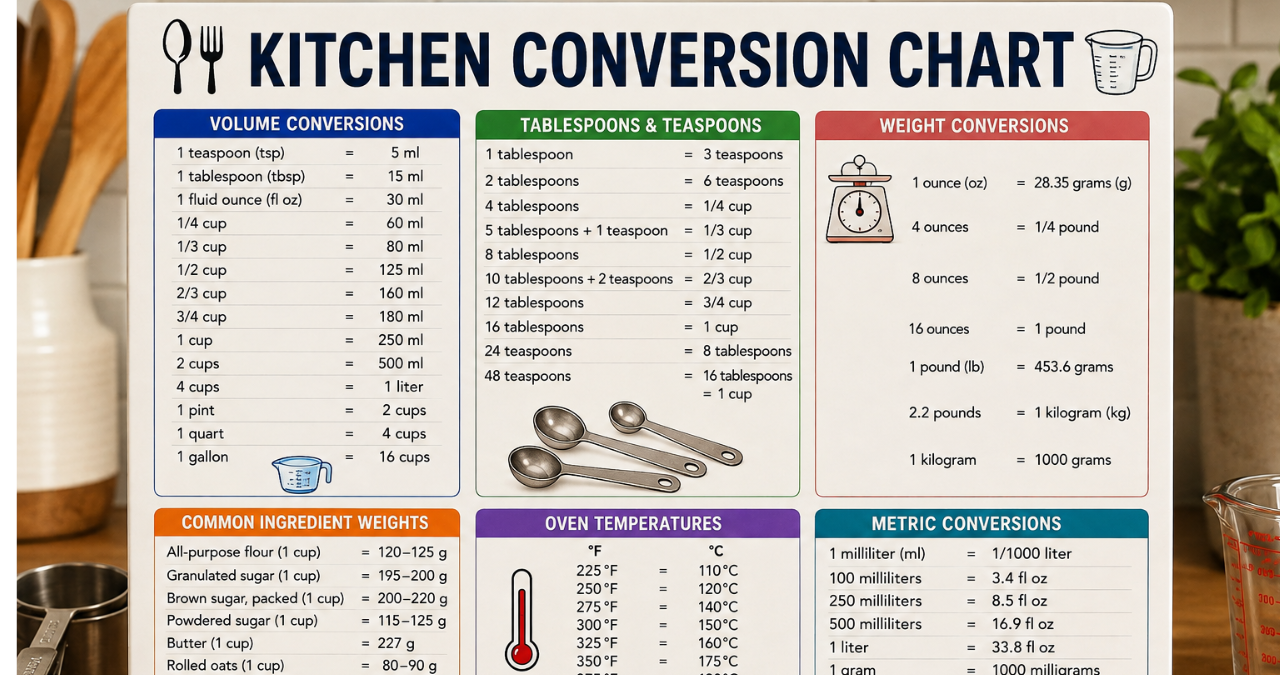
kitchen conversion chart is one of the most useful tools a home cook or baker can keep nearby. Whether you’re following a family recipe, trying an American recipe that uses cups, or working with a European recipe that lists ingredients in grams, accurate measurements can make cooking much easier. A simple conversion guide can save time, reduce mistakes, and help you feel more confident in the kitchen.
Cooking doesn’t always require perfect mathematical skills. Still, knowing how different measurements relate to one another can make a big difference. A tablespoon can become teaspoons, cups can become fluid ounces, and pounds can be converted into ounces or grams. Once these basic relationships become familiar, recipes that once looked confusing become much easier to understand.
This detailed guide explains common kitchen measurements, useful conversions, measurement tips, ingredient differences, and practical examples. It is designed in simple language so that beginners and experienced cooks alike can use it as a helpful reference.
Why a kitchen conversion chart Is Useful
Recipes come from many countries and cooking traditions. As a result, they don’t always use the same measurement system. One recipe might call for 2 cups of flour, while another might require 250 grams. A third recipe could ask for 8 ounces.
That’s where a kitchen conversion chart comes in handy.
A good conversion chart helps you:
- Understand unfamiliar recipe measurements.
- Convert cups into tablespoons or teaspoons.
- Convert ounces into pounds.
- Convert common ingredients from volume to weight.
- Work with metric and U.S. customary measurements.
- Reduce measuring mistakes.
- Adjust recipes more confidently.
- Follow international recipes more easily.
- Save time when cooking and baking.
In other words, a conversion chart is like a small kitchen calculator. You don’t have to stop cooking and work out every measurement from scratch.
Understanding the Main Kitchen Measurement Systems
Before looking at individual conversions, it’s important to understand the two main systems commonly found in recipes.
The U.S. customary system commonly uses:
- Teaspoons
- Tablespoons
- Cups
- Fluid ounces
- Pints
- Quarts
- Gallons
- Ounces
- Pounds
The metric system commonly uses:
- Milliliters
- Liters
- Grams
- Kilograms
These systems measure different things. For example, grams and kilograms measure weight or mass, while milliliters and liters measure volume.
This distinction matters because volume and weight aren’t interchangeable for every ingredient. One cup of flour does not weigh the same as one cup of sugar. Therefore, a simple cup-to-gram conversion cannot be applied equally to every ingredient.
Basic Kitchen Conversion Chart
The following table provides some of the most frequently used kitchen conversions.
| Measurement | Equivalent |
|---|---|
| 1 tablespoon | 3 teaspoons |
| 1/4 cup | 4 tablespoons |
| 1/3 cup | 5 tablespoons + 1 teaspoon |
| 1/2 cup | 8 tablespoons |
| 2/3 cup | 10 tablespoons + 2 teaspoons |
| 3/4 cup | 12 tablespoons |
| 1 cup | 16 tablespoons |
| 1 cup | 48 teaspoons |
| 1 fluid ounce | 2 tablespoons |
| 1 pint | 2 cups |
| 1 quart | 4 cups |
| 1 gallon | 16 cups |
| 1 pound | 16 ounces |
| 1 kilogram | 1,000 grams |
| 1 liter | 1,000 milliliters |
These measurements are especially useful when you don’t have a particular measuring cup available. For instance, if a recipe calls for half a cup but your half-cup measure is missing, you can use 8 tablespoons instead.
Kitchen Conversion Chart for Cups, Tablespoons, and Teaspoons
Cups, tablespoons, and teaspoons are among the most common measurements in everyday cooking.
Here are some useful relationships:
- 1 tablespoon = 3 teaspoons
- 2 tablespoons = 6 teaspoons
- 4 tablespoons = 1/4 cup
- 8 tablespoons = 1/2 cup
- 12 tablespoons = 3/4 cup
- 16 tablespoons = 1 cup
- 48 teaspoons = 1 cup
These conversions are particularly useful for sauces, spices, baking ingredients, dressings, and small recipe portions.
For example, suppose a recipe requires 1/4 cup of oil, but you only have a tablespoon measure. You can use 4 tablespoons. Simple, right?
Likewise, if a recipe asks for 2 tablespoons of an ingredient and you only have a teaspoon, you need 6 teaspoons.
Liquid Measurement Conversions
Liquid ingredients require special attention because volume measurements are normally used.
Common liquid ingredients include:
- Water
- Milk
- Cream
- Cooking oil
- Vinegar
- Juice
- Broth
- Syrups
A useful liquid conversion reference is:
| U.S. Measurement | Approximate Metric Equivalent |
|---|---|
| 1 teaspoon | 5 mL |
| 1 tablespoon | 15 mL |
| 1 fluid ounce | 30 mL |
| 1/4 cup | 60 mL |
| 1/3 cup | 80 mL |
| 1/2 cup | 120 mL |
| 2/3 cup | 160 mL |
| 3/4 cup | 180 mL |
| 1 cup | 240 mL |
| 2 cups | 480 mL |
| 4 cups | 960 mL |
These are convenient cooking approximations. Exact metric equivalents can vary slightly depending on the measurement standard being used.
For everyday cooking, however, these rounded values are usually easy to work with.
Dry Ingredient Conversions
Dry ingredients are a little more complicated.
Why? Because different ingredients have different densities.
For example, one cup of:
- Flour
- Granulated sugar
- Brown sugar
- Rice
- Oats
- Cocoa powder
will not necessarily weigh the same amount.
This is why professional bakers often prefer weighing ingredients with a kitchen scale.
Still, approximate ingredient conversions can be very useful.
Common Approximate Weight Conversions
| Ingredient | 1 Cup Approximate Weight |
|---|---|
| All-purpose flour | 120–125 g |
| Granulated sugar | 195–200 g |
| Brown sugar, packed | 200–220 g |
| Powdered sugar | 115–125 g |
| Butter | about 227 g |
| Rolled oats | about 80–90 g |
| Cocoa powder | about 80–90 g |
| Uncooked white rice | about 185–200 g |
These values are approximate because measuring methods, ingredient brands, packing, humidity, and ingredient density can affect weight.
Cups to Grams: Why the Ingredient Matters
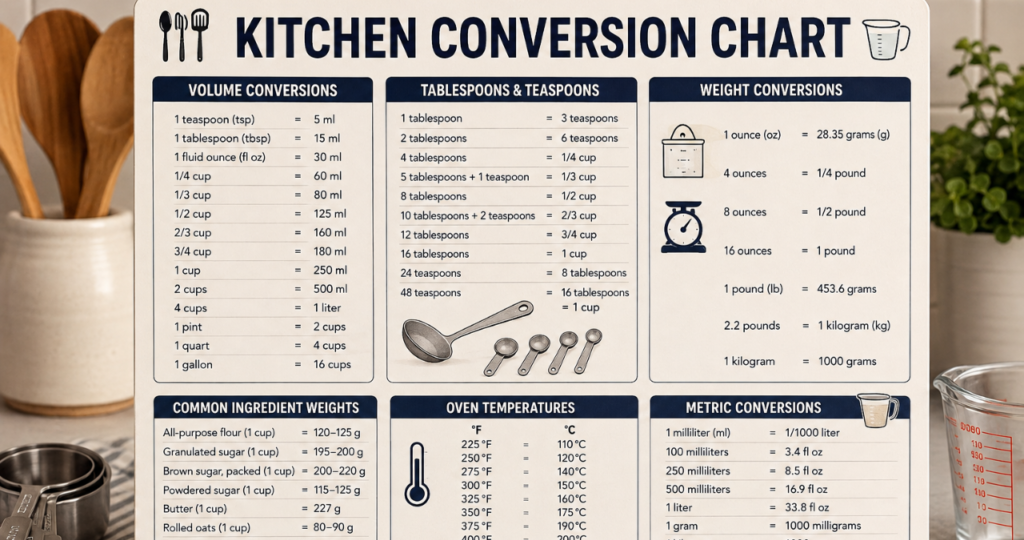
kitchen conversion chart One of the biggest mistakes beginners make is assuming that every cup weighs the same.
A cup measures volume, while grams measure mass.
Imagine filling one cup with feathers and another cup with small stones. Both containers have the same volume, but their weights are completely different.
The same principle applies to food.
A cup of flour is much lighter than a cup of sugar. A cup of chopped nuts may weigh differently from a cup of whole nuts. A cup of loosely packed brown sugar differs from a cup of firmly packed brown sugar.
For this reason, when a recipe provides a specific gram measurement, it’s generally best to use a kitchen scale rather than trying to guess the equivalent number of cups.
Kitchen Conversion Chart for Butter
Butter is an ingredient where conversions are especially helpful because recipes often list it in different ways.
Common U.S. butter measurements include:
| Butter Measurement | Approximate Weight |
|---|---|
| 1 tablespoon | 14 g |
| 2 tablespoons | 28 g |
| 1/4 cup | 57 g |
| 1/2 cup | 113 g |
| 1 cup | 227 g |
| 1 stick | 113 g |
| 2 sticks | 227 g |
These figures are based on the common U.S. butter stick system.
If you’re following a recipe from another country, check whether it gives butter by grams, ounces, sticks, or tablespoons. When accuracy matters, weighing the butter is a good approach.
Ounces, Pounds, and Grams
Weight measurements are another major part of a useful conversion guide.
The basic relationships are:
- 1 pound = 16 ounces.
- 8 ounces = 1/2 pound.
- 4 ounces = 1/4 pound.
- 1 ounce = approximately 28.35 grams.
- 1 pound = approximately 453.6 grams.
- 1 kilogram = 1,000 grams.
- 1 kilogram = approximately 2.2 pounds.
For everyday cooking, you can often round 1 ounce to 28 grams and 1 pound to 454 grams.
For baking or professional food preparation, however, more precise measurements may be preferable.
Metric Kitchen Conversion Chart
Many international recipes use metric measurements. If you’re more familiar with cups and ounces, the metric system may initially seem unfamiliar.
Here are some useful metric relationships:
| Metric Measurement | Equivalent |
|---|---|
| 1 gram | 1,000 milligrams |
| 1 kilogram | 1,000 grams |
| 1 milliliter | 1,000th of a liter |
| 1 liter | 1,000 milliliters |
| 100 mL | about 3.4 U.S. fluid ounces |
| 250 mL | about 8.5 U.S. fluid ounces |
| 500 mL | about 16.9 U.S. fluid ounces |
| 1 liter | about 33.8 U.S. fluid ounces |
Metric measurements are based on a decimal system, which makes many calculations straightforward.
For example:
- 1 kilogram = 1,000 grams.
- 500 grams = 0.5 kilogram.
- 250 grams = 0.25 kilogram.
- 1 liter = 1,000 milliliters.
- 500 milliliters = 0.5 liter.
Kitchen Conversion Chart for Recipe Scaling
Sometimes you don’t want to make the full recipe. Maybe you’re cooking for two people instead of six, or perhaps you’re preparing a large meal for a family gathering.
Recipe scaling becomes much easier when you understand conversions.
Suppose a recipe serves four people and requires:
- 2 cups of flour
- 1 cup of milk
- 2 eggs
- 1 tablespoon of oil
If you want to make half the recipe, you would use:
- 1 cup of flour
- 1/2 cup of milk
- 1 egg
- 1/2 tablespoon of oil
If you want to double it, you would use:
- 4 cups of flour
- 2 cups of milk
- 4 eggs
- 2 tablespoons of oil
However, scaling isn’t always perfectly straightforward. Baking recipes can be sensitive to changes in ingredient ratios, oven temperature, pan size, and baking time.
Measuring Cups Versus Measuring Spoons
Measuring cups and measuring spoons have different purposes.
Measuring cups
Measuring cups are generally used for larger quantities, such as:
- Flour
- Sugar
- Rice
- Milk
- Water
- Oil
- Broth
Measuring spoons
Measuring spoons are better for smaller quantities, including:
- Salt
- Pepper
- Baking powder
- Baking soda
- Vanilla extract
- Spices
- Lemon juice
Using the correct measuring tool can improve consistency.
How to Measure Dry Ingredients Correctly
Measuring flour incorrectly can change the result of baked goods.
For flour, a common method is the spoon-and-level technique.
Here’s how it works:
- Fluff the flour gently with a spoon.
- Spoon the flour into the measuring cup.
- Don’t shake or press the cup.
- Fill it slightly above the rim.
- Level the top with the straight edge of a knife.
Avoid scooping flour directly from a tightly packed container if the recipe expects the spoon-and-level method. Direct scooping can pack extra flour into the cup and lead to heavier baked goods.
Of course, if the recipe gives flour by weight, using a kitchen scale is generally more precise.
How to Measure Brown Sugar
Brown sugar is commonly measured differently from flour.
When a recipe says packed brown sugar, it means the sugar should be pressed firmly into the measuring cup.
Fill the cup and press the sugar down. Continue until the required amount is reached. When turned out, packed brown sugar should generally hold the shape of the measuring cup.
This small detail can make a surprisingly large difference in cookies, cakes, sauces, and other recipes.
Liquid Measuring Tips
For liquids, use a clear liquid measuring cup when measuring larger amounts.
Place the cup on a flat surface and look at the measurement at eye level. Don’t hold the cup in the air while trying to judge the level.
For small amounts, use measuring spoons.
This approach helps prevent common mistakes, especially when working with recipes that require precise liquid ratios.
Common Kitchen Conversion Mistakes
Even experienced cooks can make measurement mistakes from time to time. The good news is that most are easy to avoid.
Confusing fluid ounces with weight ounces
A fluid ounce measures volume, while an ounce on a food scale measures weight.
They’re not automatically interchangeable.
Assuming every cup weighs the same
As explained earlier, ingredient density matters.
Forgetting packed measurements
Brown sugar is a classic example. A cup of packed brown sugar isn’t the same as a cup of loosely filled brown sugar.
Using the wrong measuring cup
Liquid measuring cups and dry measuring cups are designed for different measuring methods.
Relying on rough estimates when baking
A pinch of extra seasoning might not matter much in soup, but inaccurate flour or leavening measurements can affect a cake or loaf.
When Should You Use a Kitchen Scale?
A kitchen scale is especially useful when:
- Baking bread.
- Making pastries.
- Following recipes written in grams.
- Measuring flour.
- Tracking exact ingredient quantities.
- Scaling recipes.
- Preparing consistent portions.
For professional-quality baking, weight measurements are often more reliable than volume measurements.
That doesn’t mean cups are bad. Far from it! Cups and spoons remain convenient and practical for many everyday recipes. A scale simply offers another level of precision.
Tips for Creating Consistent Results
Cooking is both a science and an art. You don’t have to measure every grain of salt, but consistency becomes important when you’re trying to reproduce a successful recipe.
Try these habits:
- Read the entire recipe before starting.
- Gather your measuring tools first.
- Check whether ingredients are measured by weight or volume.
- Pay attention to words such as “packed,” “sifted,” and “level.”
- Use a scale when the recipe gives weights.
- Keep a conversion chart in your kitchen.
- Write down adjustments you make to recipes.
- Don’t automatically substitute weight for volume without checking the ingredient.
A little preparation goes a long way.
Quick Reference Kitchen Conversion Chart
When you’re in the middle of cooking, you probably don’t want to read a long explanation. You want the answer quickly.
Here’s a compact reference:
| Need to Convert | Useful Conversion |
|---|---|
| Teaspoons to tablespoons | 3 tsp = 1 tbsp |
| Tablespoons to cups | 16 tbsp = 1 cup |
| Cups to tablespoons | 1 cup = 16 tbsp |
| Cups to teaspoons | 1 cup = 48 tsp |
| Cups to pints | 2 cups = 1 pint |
| Cups to quarts | 4 cups = 1 quart |
| Cups to gallons | 16 cups = 1 gallon |
| Ounces to pounds | 16 oz = 1 lb |
| Pounds to grams | 1 lb ≈ 454 g |
| Ounces to grams | 1 oz ≈ 28.35 g |
| Kilograms to grams | 1 kg = 1,000 g |
| Liters to milliliters | 1 L = 1,000 mL |
| Tablespoon to milliliters | 1 tbsp ≈ 15 mL |
| Teaspoon to milliliters | 1 tsp ≈ 5 mL |
Kitchen Conversion Chart for Everyday Cooking
Let’s look at a practical example.
Imagine you’re making a soup recipe that requires:
- 4 cups of broth
- 2 tablespoons of oil
- 1 teaspoon of salt
- 1/2 cup of chopped vegetables
If you want to understand those measurements in smaller units:
- 4 cups of broth = 64 tablespoons.
- 2 tablespoons of oil = 6 teaspoons.
- 1 teaspoon of salt remains 1 teaspoon.
- 1/2 cup = 8 tablespoons.
You probably wouldn’t measure the broth with 64 tablespoons because that would be rather tedious! Still, understanding the relationship helps when you need to adapt a recipe.
Baking and the Importance of Accuracy
Baking deserves special attention because it depends heavily on ratios.
A cake isn’t simply a mixture of ingredients thrown into a bowl. Flour, sugar, fat, eggs, liquid, and leavening agents work together in a carefully balanced system.
Small measurement errors can affect:
- Texture
- Rise
- Moisture
- Browning
- Flavor
- Structure
For this reason, bakers often prefer weighing ingredients.
If a recipe says 300 grams of flour, don’t assume that any generic “2 cups” measurement will produce exactly the same result. Flour can be packed differently from one kitchen to another.
How to Keep a Conversion Reference Handy
A conversion chart is most useful when it’s easy to access.
You can:
- Print a chart and place it inside a cabinet.
- Keep one near your baking supplies.
- Save a digital copy on your phone.
- Write frequently used conversions in a recipe notebook.
- Keep a small chart near your kitchen scale.
The goal isn’t to memorize every conversion. That’s not necessary. Instead, keep the information available so you can check it when needed.
Frequently Asked Questions
How many teaspoons are in a tablespoon?
There are 3 teaspoons in 1 tablespoon.
How many tablespoons are in a cup?
There are 16 tablespoons in 1 U.S. cup.
How many ounces are in a pound?
There are 16 ounces in 1 pound.
How many grams are in an ounce?
One ounce is approximately 28.35 grams.
Is one cup always the same weight?
No. A cup measures volume, so the weight depends on the ingredient.
Is 1 cup equal to 250 mL?
Not exactly in the U.S. customary system. A U.S. cup is approximately 237 mL, although many cooking references round it to 240 mL. Some metric recipes use a 250 mL cup, so always check the recipe’s measurement system.
Should I use cups or grams?
For many everyday recipes, either can work. For baking, weighing ingredients in grams often provides greater consistency.
Can I convert every ingredient from cups to grams?
You can estimate many ingredients, but there isn’t one universal cups-to-grams number. The correct weight depends on the ingredient and how it is measured.
Final Thoughts
A reliable kitchen conversion chart can make everyday cooking simpler, faster, and more enjoyable. From converting teaspoons into tablespoons to understanding cups, ounces, pounds, grams, and milliliters, these basic measurements help you follow recipes with confidence.
The most important lesson is that volume and weight are different types of measurement. A cup doesn’t have one universal weight because different ingredients have different densities. When accuracy matters—especially in baking—a kitchen scale is often the best choice.
At the same time, there’s no need to overcomplicate things. Keep a practical kitchen conversion chart nearby, learn the most common measurements, pay attention to recipe instructions, and use the right measuring tool for the job. With these simple habits, you’ll be better prepared to tackle everything from quick weekday meals to detailed baking projects.