
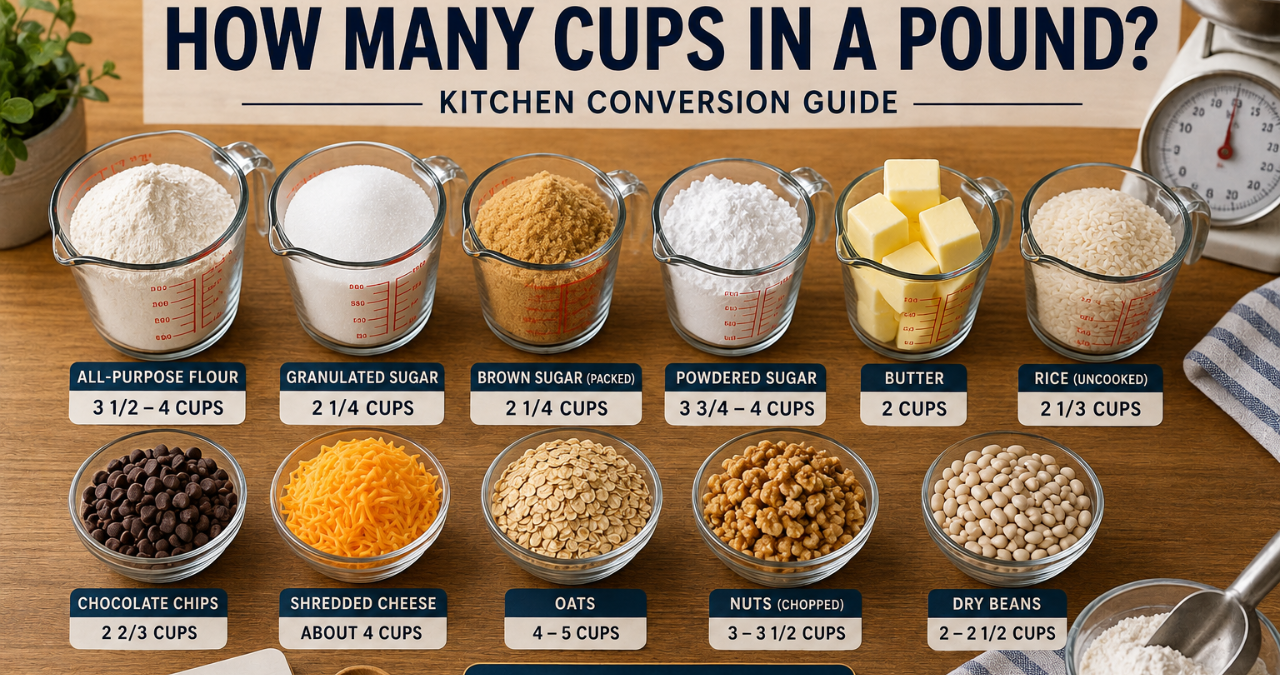
How many cups in a pound is a common question for home cooks, bakers, students, and anyone following a recipe. At first glance, the answer may seem simple, but there is one important detail to understand: a pound measures weight, while a cup measures volume.
Because of this difference, there isn’t one fixed answer for every ingredient.
For example, one pound of flour does not take up the same number of cups as one pound of sugar, butter, rice, or shredded cheese. Different ingredients have different densities and shapes. Some are light and fluffy, while others are heavy and compact.
As a general guide:
- 1 pound of all-purpose flour is about 3 1/2 to 4 cups.
- 1 pound of granulated sugar is about 2 1/4 cups.
- 1 pound of butter is 2 cups.
- 1 pound of powdered sugar is about 3 3/4 to 4 cups.
- 1 pound of brown sugar is about 2 1/4 cups when packed.
- 1 pound of uncooked rice is about 2 1/3 cups, depending on the variety.
So, if you’ve ever wondered, how many cups in a pound, the best answer is: it depends on what you are measuring.
This article explains the difference between cups and pounds, provides useful conversion charts, and shows you how to get accurate measurements in your kitchen.
Why Pounds and Cups Are Different
Before learning conversions, it helps to understand what these measurements actually mean.
A pound (lb) is a unit of weight or mass. It tells you how heavy something is.
A cup is mainly a unit of volume. It tells you how much space an ingredient takes up.
Think about a pound of feathers and a pound of rocks. Both weigh one pound, but they would take up very different amounts of space. Feathers are light and fluffy, while rocks are dense.
The same idea applies to cooking ingredients.
A pound of flour contains air between its tiny particles. A pound of sugar is more compact. A pound of butter is even more dense. Therefore, each ingredient produces a different number of cups.
This is why simply saying “one pound equals four cups” isn’t always correct.
How Many Cups in a Pound of Common Ingredients?
The following table gives approximate conversions for several ingredients commonly used in cooking and baking.
| Ingredient | Approximate Cups in 1 Pound |
|---|---|
| All-purpose flour | 3 1/2–4 cups |
| Bread flour | 3 1/2–4 cups |
| Whole wheat flour | About 3 1/2 cups |
| Granulated sugar | About 2 1/4 cups |
| Powdered sugar | About 3 3/4–4 cups |
| Brown sugar, packed | About 2 1/4 cups |
| Butter | 2 cups |
| Shortening | About 2 1/4 cups |
| Rolled oats | About 4–5 cups |
| Uncooked white rice | About 2 1/3 cups |
| Chocolate chips | About 2 2/3 cups |
| Chopped nuts | About 3–3 1/2 cups |
| Shredded cheese | About 4 cups |
| Dry beans | About 2–2 1/2 cups |
These numbers are estimates. The exact amount can change because of ingredient type, particle size, moisture, packing method, and how the cup is filled.
How Many Cups in a Pound of Flour?
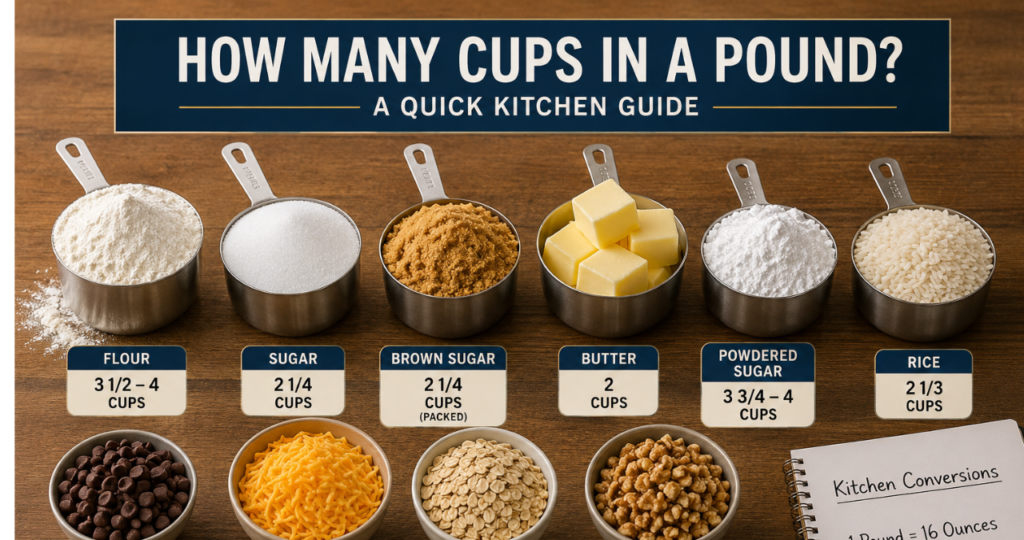
How many cups in a pound Flour is one of the ingredients that causes the most confusion.
A pound of all-purpose flour is generally around 3 1/2 to 4 cups. Many kitchen guides use approximately 3 2/3 cups as a practical estimate.
However, flour can be measured in different ways.
If flour is scooped directly from a bag with a measuring cup, it may become packed. This can place more flour into the cup than expected. If flour is gently spooned into the cup and leveled, the measurement is usually lighter.
For baking, this difference matters.
Tips for Measuring Flour
For better results:
- Fluff the flour with a spoon before measuring.
- Spoon flour into the measuring cup.
- Don’t press the flour down.
- Level the top with a straight edge.
- Avoid shaking the cup while filling it.
- Use a kitchen scale when exact measurements matter.
A small difference might not ruin a simple recipe, but too much flour can make cakes, cookies, and bread heavy or dry.
How Many Cups in a Pound of Sugar?
Sugar is much denser than flour, so one pound of sugar takes up fewer cups.
Granulated Sugar
One pound of regular granulated sugar is approximately 2 1/4 cups.
Granulated sugar has small crystals that fit together more closely than flour particles. That’s why you get fewer cups from the same one-pound weight.
Powdered Sugar
Powdered sugar is lighter and contains very fine particles. One pound is usually around 3 3/4 to 4 cups, depending on whether it is sifted.
Brown Sugar
Brown sugar is usually measured differently because recipes often require it to be packed firmly into the measuring cup.
One pound of packed brown sugar is approximately 2 1/4 cups.
If brown sugar is loosely placed in a cup, the result may be different.
How Many Cups in a Pound of Butter?
This is one of the easiest conversions to remember.
One pound of butter equals 2 cups.
In the United States, butter is commonly sold in sticks. One standard stick contains 1/2 cup, so:
- 1 stick = 1/2 cup
- 2 sticks = 1 cup
- 4 sticks = 2 cups
- 1 pound = 4 sticks = 2 cups
This makes butter particularly easy to convert from pounds to cups.
Still, it’s wise to check the package because butter packaging can differ in different countries.
How Many Cups in a Pound of Rice?
Rice is another ingredient where the answer depends on the variety.
One pound of uncooked white rice is generally around 2 1/3 cups.
Long-grain rice, short-grain rice, jasmine rice, basmati rice, and other varieties can have slightly different densities.
Cooking also changes the volume dramatically.
For example, one cup of uncooked rice can produce several cups of cooked rice because the grains absorb water. So be careful when a recipe asks for a pound of cooked rice instead of uncooked rice.
The same ingredient can have very different cup measurements depending on whether it is raw or cooked.
How Many Cups in a Pound of Brown Sugar?
Brown sugar deserves special attention because of the way it is measured.
When a recipe says 1 cup packed brown sugar, it means you should press the sugar firmly into the cup until it holds its shape when turned out.
One pound of packed brown sugar is approximately 2 1/4 cups.
Why Does Packing Matter?
Brown sugar contains moisture, which helps it stick together. When you press it into a measuring cup, the sugar becomes more compact.
For example, a loosely filled cup might contain less sugar by weight than a firmly packed cup.
That’s why recipes are usually specific about whether brown sugar should be packed.
How Many Cups in a Pound of Powdered Sugar?
Powdered sugar is also called confectioners’ sugar or icing sugar in many places.
One pound of powdered sugar is generally around 3 3/4 to 4 cups.
However, sifted powdered sugar can occupy more space because sifting adds air between the fine particles.
This is important when making:
- Frosting
- Icing
- Glazes
- Cakes
- Cookies
- Dessert toppings
If a recipe says “1 pound powdered sugar,” weighing it is the safest method. If the recipe says “4 cups sifted powdered sugar,” the instructions may produce a different weight.
How Many Cups in a Pound of Chocolate Chips?
Chocolate chips are heavier than flour but lighter than many compact ingredients.
A pound of chocolate chips is approximately 2 2/3 cups.
The exact number can vary depending on the size and shape of the chocolate chips.
Mini chocolate chips may fit differently from large chocolate chunks. Chopped chocolate can also have a different volume because the pieces aren’t uniform.
When making cookies or brownies, a small difference usually isn’t a disaster. Still, accurate measuring helps maintain the right balance of chocolate, flour, sugar, and fat.
How Many Cups in a Pound of Cheese?
Cheese can be especially tricky because it may be measured as a block, shredded, sliced, or crumbled ingredient.
A pound of shredded cheese is often around 4 cups, although the exact amount varies.
For example:
- Finely shredded cheese may fit more tightly.
- Thick shreds may leave more air between pieces.
- Crumbled cheese can have a different volume.
- A solid block should be weighed rather than estimated from cups.
If you’re making pizza, pasta, casseroles, or sandwiches, the exact amount may not need to be perfect. For baking or carefully balanced recipes, weighing cheese is more reliable.
How Many Cups in a Pound of Nuts?
Nuts can have surprisingly different cup-to-pound conversions.
One pound of nuts may equal roughly 3 to 3 1/2 cups, depending on the type and whether the nuts are whole or chopped.
For example, chopped nuts can fit differently from whole nuts because small pieces fill gaps between each other.
Common nuts include:
- Almonds
- Walnuts
- Pecans
- Cashews
- Peanuts
- Pistachios
If a recipe calls for one pound of nuts, using a kitchen scale is the easiest way to avoid guessing.
Weight vs. Volume: The Important Difference
The biggest lesson when learning how many cups in a pound is understanding the difference between weight and volume.
Weight
Weight tells you how heavy an ingredient is.
Common weight measurements include:
- Pounds
- Ounces
- Grams
- Kilograms
Volume
Volume tells you how much space an ingredient occupies.
Common volume measurements include:
- Cups
- Tablespoons
- Teaspoons
- Fluid ounces
- Liters
- Milliliters
A pound of one ingredient won’t necessarily have the same volume as a pound of another ingredient.
That’s why professional bakers often use grams instead of cups.
Why a Kitchen Scale Is So Helpful
If you cook often, a digital kitchen scale can be a real game changer.
A scale measures the actual weight of the ingredient rather than estimating its volume.
For example, instead of measuring several cups of flour, a recipe may tell you to use 450 grams. You simply place a bowl on the scale, set it to zero, and add the flour.
Benefits of Using a Kitchen Scale
A kitchen scale can:
- Improve baking accuracy.
- Reduce measuring mistakes.
- Make recipes easier to repeat.
- Help with portion control.
- Reduce dirty measuring cups.
- Make ingredient conversions easier.
- Provide consistent results.
For serious baking, weighing ingredients is often the best approach.
Common Mistakes When Converting Pounds to Cups
People often make a few simple mistakes when converting measurements.
Assuming Every Pound Equals the Same Number of Cups
This is the most common error.
One pound of butter is two cups, but one pound of flour is roughly four cups. The difference comes from density.
Packing Ingredients Without Checking the Recipe
Some ingredients should be packed, while others should be loose.
Brown sugar is commonly packed. Flour is usually not packed.
Ignoring Ingredient Form
A pound of whole almonds isn’t the same volume as a pound of chopped almonds.
Likewise, a pound of cooked rice isn’t the same volume as a pound of uncooked rice.
Using Liquid Measurements for Dry Ingredients
A measuring cup designed for liquids can be awkward for flour, sugar, and other dry ingredients.
For dry ingredients, use dry measuring cups or, better yet, a kitchen scale.
How to Convert Pounds to Cups More Accurately
If you need to convert a pound into cups, follow these steps.
Identify the Ingredient
First, find out exactly what you’re measuring.
Is it flour, sugar, butter, rice, oats, cheese, or something else?
Check the Ingredient’s Weight per Cup
Find a reliable measurement for how much one cup of that ingredient weighs.
Use a Simple Formula
If you know the weight of one cup, you can estimate the number of cups in one pound.
Since one pound contains 16 ounces, the basic idea is:
Cups in one pound = 16 ounces ÷ ounces per cup
For example, if one cup of an ingredient weighs 4 ounces:
16 ÷ 4 = 4 cups
This works as an estimate when the ingredient is measured consistently.
Quick Conversion Guide for Home Cooks
Here’s a simple reference you can keep handy.
| Ingredient | 1 Pound Is Approximately |
|---|---|
| Flour | 3 1/2–4 cups |
| Granulated sugar | 2 1/4 cups |
| Brown sugar | 2 1/4 cups packed |
| Powdered sugar | 3 3/4–4 cups |
| Butter | 2 cups |
| Rice | 2 1/3 cups |
| Chocolate chips | 2 2/3 cups |
| Shredded cheese | About 4 cups |
| Oats | 4–5 cups |
| Nuts | 3–3 1/2 cups |
Remember, these are practical estimates rather than universal rules.
Cups to Pounds: Can You Reverse the Conversion?
Yes, you can convert cups to pounds, but once again, the ingredient matters.
For example, if one pound of butter equals two cups, then:
- 1 cup butter = 1/2 pound
- 1/2 cup butter = 1/4 pound
- 1/4 cup butter = 1/8 pound
But you can’t apply the same rule to flour.
If one pound of flour is about four cups:
- 1 cup flour = about 1/4 pound
- 2 cups flour = about 1/2 pound
- 3 cups flour = about 3/4 pound
- 4 cups flour = about 1 pound
These examples show why ingredient-specific conversions are essential.
How Measuring Methods Change Results
Even when you’re using the same ingredient, your method can affect the result.
Imagine measuring flour.
If you scoop a cup directly from a large bag, the flour may become compressed. If you spoon flour into the cup and level it, less flour may fit.
This means two people can use “one cup of flour” and end up with slightly different amounts.
For everyday cooking, this may not matter much.
For baking, however, precision can make a noticeable difference.
The Spoon-and-Level Method
A simple method for dry ingredients is:
- Stir or fluff the ingredient.
- Spoon it gently into the measuring cup.
- Let it fall naturally.
- Fill the cup to the top.
- Level the surface with a knife or straight edge.
Don’t press it down unless the recipe specifically says to do so.
When Should You Use Cups?
Cups are convenient and quick.
They’re especially useful for:
- Everyday cooking
- Soups
- Sauces
- Simple desserts
- Family recipes
- Recipes written in cups
Cups are easy to use and widely available.
For many recipes, approximate measurements are perfectly fine.
When Should You Use Pounds or a Scale?
Weight measurements are especially useful when:
- Baking bread
- Making pastries
- Preparing cakes
- Following professional recipes
- Repeating a recipe regularly
- Measuring expensive ingredients
- Working with large quantities
A scale removes much of the guesswork.
As the saying goes, “measure twice, cut once.” In the kitchen, accurate measuring can save ingredients, time, and frustration.
Tips for Better Kitchen Measurements
Here are some practical tips to help you get consistent results:
- Read the entire recipe before starting.
- Check whether the ingredient should be packed or loose.
- Don’t assume all pounds equal the same number of cups.
- Use dry measuring cups for dry ingredients.
- Use liquid measuring cups for liquids.
- Level dry ingredients when appropriate.
- Use a digital scale for precise baking.
- Check whether an ingredient is raw, cooked, whole, chopped, or shredded.
- Keep a conversion chart nearby.
- Follow the recipe’s specific instructions whenever possible.
Frequently Asked Questions
How many cups in a pound of flour?
One pound of all-purpose flour is approximately 3 1/2 to 4 cups. The exact amount depends on the flour and how it is measured.
How many cups in a pound of sugar?
One pound of granulated sugar is approximately 2 1/4 cups.
How many cups in a pound of butter?
One pound of butter equals 2 cups or approximately four standard sticks.
Is one pound always four cups?
No. This is a common misunderstanding. The number of cups in a pound depends on the ingredient’s density.
How many cups are in a pound of powdered sugar?
One pound of powdered sugar is generally about 3 3/4 to 4 cups, depending on whether it is sifted.
How many cups are in a pound of brown sugar?
One pound of packed brown sugar is approximately 2 1/4 cups.
Why are cup measurements different for every ingredient?
Because cups measure volume and pounds measure weight. Different ingredients have different densities, so they occupy different amounts of space.
Is weighing ingredients better than measuring cups?
For accurate baking, yes. A kitchen scale usually gives more consistent results than volume measurements.
Final Thoughts on How Many Cups in a Pound
Understanding how many cups in a pound doesn’t have to be confusing. The key is to remember that pounds measure weight, while cups measure volume. Since ingredients have different densities, there isn’t one universal cups-to-pound conversion.
For quick kitchen work, a conversion chart can be very useful. Flour, sugar, butter, rice, cheese, nuts, and other ingredients all have their own approximate measurements. When precision matters, especially in baking, a digital kitchen scale is the safest choice.
So, the next time a recipe asks for a pound and you only have measuring cups, don’t panic. Check the ingredient, use a reliable conversion, and measure carefully. With a little practice, how many cups in a pound will become an easy kitchen question to answer.