
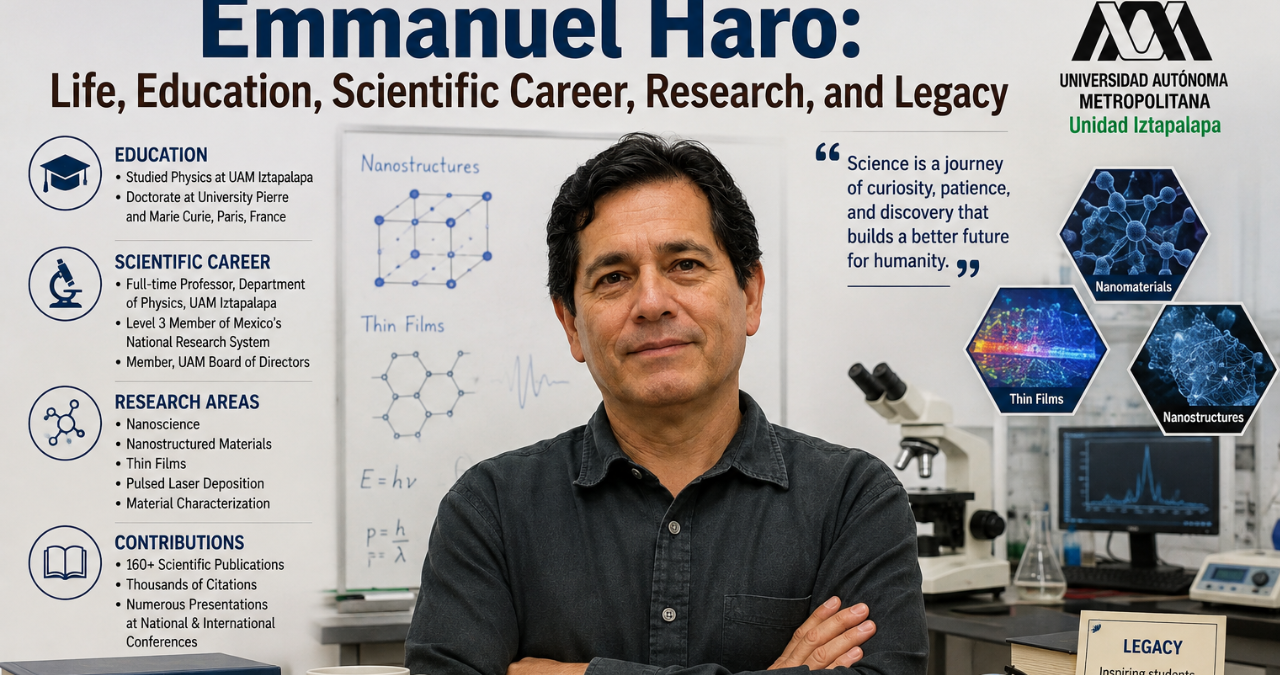
Emmanuel Haro is a name connected with more than one public story, so it is important to identify the person being discussed. One notable Emmanuel Haro is Dr. Emmanuel Haro Poniatowski, a Mexican physicist and university professor associated with the Universidad Autónoma Metropolitana (UAM). His career has focused on physics, solid-state physics, nanoscience, thin films, nanostructured materials, and related research. UAM lists him as a full-time professor in its Department of Physics at the Iztapalapa campus.
This article focuses mainly on Emmanuel Haro Poniatowski, whose academic career has made him an established figure in Mexican scientific research. Public sources also show that the name “Emmanuel Haro” belongs to other individuals, including a former Mexican youth football player and a child involved in a widely reported U.S. criminal case. Therefore, readers should be careful not to mix information about different people who share the same name.
Who Is Emmanuel Haro?
Emmanuel Haro Poniatowski is a Mexican physicist whose professional work is closely connected with higher education and scientific research. He has spent much of his career at the Universidad Autónoma Metropolitana, commonly known as UAM, where he works in the Department of Physics at the Iztapalapa campus.
His scientific profile places him in the area of physics, with particular expertise in solid-state physics and nanoscience. Mexico’s National System of Researchers, now represented through the national scientific research system, lists him at Level 3 in the field of Physics and identifies nanoscience as his specialty.
That combination of teaching and research is important. Universities don’t only need people who understand scientific ideas; they also need researchers who can explore unanswered questions, publish findings, guide students, and contribute to the wider scientific community.
In that sense, Emmanuel Haro represents the type of academic career built over many years rather than overnight fame.
Emmanuel Haro and His Family Background
One reason Emmanuel Haro Poniatowski has attracted public attention outside scientific circles is his family background.
He is the son of Guillermo Haro, a prominent Mexican astronomer, and Elena Poniatowska, the internationally recognized Mexican writer and journalist. Public biographies identify Emmanuel Haro Poniatowski as one of their children.
Having famous parents can bring public attention, but a person’s professional achievements still need to be considered on their own merits. In Emmanuel Haro’s case, his academic career developed in physics and scientific research.
His background also creates an interesting connection between science and literature. His father was associated with astronomy, while his mother became one of Mexico’s best-known writers. Emmanuel chose a scientific path, continuing a strong tradition of intellectual work in his family.
Interestingly, Elena Poniatowska has spoken publicly about curiosity and investigation, qualities that are also central to scientific thinking.
Education of Emmanuel Haro
Education played a major role in Emmanuel Haro’s development as a scientist.
According to information published by UAM, he studied for a Bachelor’s degree in Physics at UAM’s Iztapalapa campus. He later spent time conducting research in France and subsequently completed doctoral studies at the University Pierre and Marie Curie in Paris.
This educational path gave him experience in both Mexican and international academic environments.
His academic journey included:
- Undergraduate studies in Physics at UAM Iztapalapa
- Research experience in France
- Doctoral study at the University Pierre and Marie Curie
- Continued scientific research after completing his doctorate
- University teaching and academic leadership
- Participation in scientific committees and evaluation activities
This is a good example of how a scientific career often develops step by step. First comes education, then research training, followed by teaching, publications, collaboration, and broader academic responsibilities.
Emmanuel Haro’s Career at UAM
The Universidad Autónoma Metropolitana has been an important part of Emmanuel Haro’s professional life.
UAM currently identifies him as a full-time Professor in the Department of Physics, within the Division of Basic Sciences and Engineering at the Iztapalapa campus. The university also lists him as a Level 3 member of the national research system.
Being a full-time professor involves much more than standing in front of a classroom. University researchers commonly divide their time among:
- Teaching students
- Conducting laboratory research
- Writing scientific papers
- Working with research teams
- Presenting scientific findings
- Advising students
- Participating in academic committees
- Reviewing scientific work
Over the years, Haro has taken part in many of these areas.
His work shows how universities can serve as both educational institutions and centers for scientific discovery.
His Role in Scientific Research
The scientific profile of Emmanuel Haro is especially connected with nanoscience and nanostructured materials.
Nanoscience studies materials and structures at extremely small scales. At these dimensions, materials can behave differently from the same materials at larger scales. This makes nanoscience useful in areas such as electronics, optics, energy, medicine, sensors, and advanced manufacturing.
Haro’s research profile includes areas such as:
- Nanostructures
- Thin films
- Nanomaterials
- Material characterization
- Pulsed laser deposition
- Nanostructured material synthesis
His research profile lists more than 160 publications and thousands of citations on ResearchGate, showing a substantial scholarly record.
Of course, publication counts can change as new papers are released and databases update. For that reason, individual publication databases should be treated as changing records rather than permanent totals.
Understanding Nanoscience
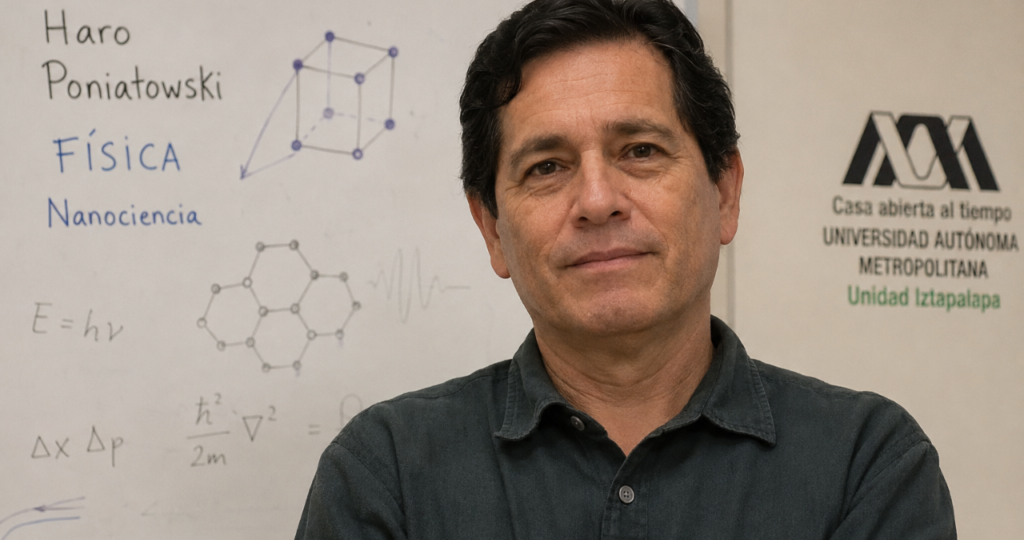
Emmanuel Haro To understand why Emmanuel Haro’s research matters, it helps to understand nanoscience in simple terms.
A nanometer is extremely small—one billionth of a meter. For comparison, a human hair is roughly tens of thousands of nanometers wide.
At this scale, scientists can study how atoms and molecules interact and how these interactions affect the properties of materials.
For example, researchers may investigate:
- How a material absorbs light
- How electricity moves through a material
- How surfaces react with other substances
- How tiny particles behave
- How materials can be made stronger or more useful
- How thin layers can be used in technology
This field is challenging, but it can also open doors to new technology.
Emmanuel Haro and Thin-Film Research
One important area associated with Emmanuel Haro’s scientific work is thin-film research.
A thin film is a very small layer of material placed on another surface. Thin films are used in many modern technologies, including electronic components, optical devices, sensors, coatings, and energy-related systems.
Researchers study thin films to understand their:
- Structure
- Chemical composition
- Optical properties
- Electrical properties
- Surface behavior
- Stability
The goal is often to control the material at a very small scale so it performs a particular function.
Research profiles associated with Haro include work involving pulsed laser deposition, a technique used to create thin films and investigate advanced materials.
Scientific Publications and Research Contributions
Scientific publications are one of the main ways researchers share discoveries.
Emmanuel Haro Poniatowski has contributed to research publications involving nanostructured materials and related areas. UAM’s research catalog provides links to his academic work through platforms such as Google Scholar, ResearchGate, and Scopus.
One example listed in his recent research record concerns the investigation of copper chloride nanocrystals embedded in glass, exploring their potential as a platform for optical switching. The work appeared in Ceramics International in 2025.
Research like this demonstrates how materials science can connect fundamental physics with possible future technologies.
The journey from a laboratory experiment to a useful commercial product can take years. Still, fundamental research provides the building blocks that later scientists and engineers can develop.
Emmanuel Haro’s Academic Leadership
A scientific career isn’t limited to laboratory work.
In 2017, the Academic College of UAM elected Emmanuel Haro Poniatowski as a member of the university’s Board of Directors (Junta Directiva). He replaced Fernando Rojas González in that position.
This appointment reflected institutional confidence in his academic experience.
His professional activities have also included participation in external evaluation committees. UAM reported that he had served on committees connected with institutions including the Centro de Investigación en Materiales Avanzados (CIMAV) and the Instituto Nacional de Astrofísica, Óptica y Electrónica (INAOE).
These roles matter because scientific institutions depend on experienced researchers to evaluate projects, research quality, and academic proposals.
Emmanuel Haro’s Experience in the National Research System
Another important part of Emmanuel Haro’s career is his participation in Mexico’s national research system.
The national scientific researcher profile lists him as:
| Category | Information |
|---|---|
| Name | Emmanuel Haro Poniatowski |
| Field | Physics |
| Area | Physical-Mathematical and Earth Sciences |
| Discipline | Solid-State Physics |
| Specialty | Nanoscience |
| Institution | Universidad Autónoma Metropolitana |
| Campus | Iztapalapa |
| Research Level | Level 3 |
The national research profile records his Level 3 status with a current period extending from 2022 through 2031.
This provides useful evidence that his work has been recognized within Mexico’s formal research system.
Presentations and International Experience
Scientific progress depends heavily on communication.
Researchers need to explain their work to colleagues, students, institutions, and sometimes the public. Emmanuel Haro’s academic record includes significant participation in scientific presentations.
A UAM announcement from 2017 stated that he had presented papers or participated in 142 academic activities. It also noted that he had been a member of Mexico’s national researcher system since 1987 and had reached Level III in 2002 under the system then in place.
He also had experience as a visiting professor at the University of Paris, according to contemporary reporting.
International academic experience can be valuable because scientific research is naturally collaborative. Ideas cross borders, laboratories share techniques, and researchers learn from different academic traditions.
Why Emmanuel Haro’s Research Matters
At first glance, nanoscience may sound highly technical. However, its potential importance is much easier to understand when we look at everyday technology.
Nanomaterials and thin films can contribute to developments in:
- Electronic devices
- Optical systems
- Sensors
- Energy technology
- Advanced coatings
- Communication systems
- Materials engineering
- Scientific instruments
Research doesn’t always produce an immediate product. Sometimes the real value is learning something new about how materials behave.
That knowledge can later become the foundation for an invention.
As the saying goes, Rome wasn’t built in a day. Scientific progress works in much the same way. One experiment can lead to another, and one discovery can eventually support an entirely new technology.
The Importance of Teaching in Emmanuel Haro’s Career
Research is only one side of academic life.
As a university professor, Emmanuel Haro also contributes to education. Professors in scientific departments help students understand difficult concepts and encourage them to think independently.
Physics can be challenging for students because it combines mathematics, observation, experimentation, and abstract ideas.
A good teacher can make those ideas easier to understand by connecting theory to real-world examples.
For example, students can learn about:
- Forces through everyday motion
- Electricity through household devices
- Light through cameras and displays
- Materials through electronics
- Atomic structures through modern technology
The next generation of scientists depends on this kind of education.
Emmanuel Haro and the Value of Curiosity
Curiosity is one of the most important qualities in science.
Scientists don’t simply accept that something works. They ask:
Why does it work?
Then they ask:
Can we make it work better?
This way of thinking is especially important in nanoscience because researchers investigate things that are too small to see with ordinary methods.
The scientific career of Emmanuel Haro demonstrates the value of long-term curiosity, careful research, and continued education.
His work also shows that science isn’t just about memorizing formulas. It’s about asking useful questions and finding reliable ways to answer them.
Emmanuel Haro’s Professional Recognition
Several indicators demonstrate the professional standing of Emmanuel Haro Poniatowski.
These include:
- A long academic career at UAM
- Full-time professorship
- Level 3 recognition in Mexico’s national research system
- A large body of scientific publications
- International research experience
- Participation in academic committees
- Service on UAM’s Board of Directors
- Work involving nanoscience and solid-state physics
UAM’s official profile confirms his current association with its Department of Physics, while Mexico’s national research listing provides information about his research field and recognition.
Together, these details provide a clearer picture of his career than a simple biography or list of achievements.
A Note About Other People Named Emmanuel Haro
It’s worth making an important distinction.
The name Emmanuel Haro doesn’t refer to only one person.
For example, another Emmanuel Haro, whose full name is listed as Emmanuel Haro Gastelum, was a Mexican football player born in Tijuana in 2001. His records show experience with youth teams including Tijuana U20, Cruz Azul U20, and Mexico U18.
There is also a much more recent news story involving a baby named Emmanuel Haro in California. That case is completely unrelated to the Mexican physicist Emmanuel Haro Poniatowski.
This distinction is essential for accurate research.
When searching online, readers should check:
- Full name
- Profession
- Country
- Age
- Institution
- Dates
- Family background
Doing so helps prevent unrelated information from being combined into one biography.
Emmanuel Haro’s Place in Mexican Science
Mexico has a long history of scientific research across astronomy, physics, chemistry, engineering, medicine, and other fields.
Emmanuel Haro Poniatowski belongs to a generation of researchers who have contributed to modern physics and materials science through university-based research.
His work at UAM is particularly relevant because universities play a central role in scientific development. They educate students while also creating new knowledge.
The connection between education and research is powerful. Students learn established scientific principles, while researchers push the boundaries of what is already known.
That’s where academic science can make a real difference.
Lessons From Emmanuel Haro’s Career
There are several useful lessons that readers and young students can take from Emmanuel Haro’s professional journey.
Education Takes Time
A scientific career usually requires years of study. Undergraduate education may be only the beginning. Advanced research often requires postgraduate study and specialized training.
Curiosity Matters
Science begins with questions. Curiosity encourages researchers to look deeper instead of simply accepting the first answer.
International Experience Can Help
Emmanuel Haro’s academic experience included research in France and doctoral study in Paris.
Working across academic environments can introduce researchers to different methods and ideas.
Research Requires Patience
Scientific experiments don’t always work the first time. Researchers must test, measure, revise, and try again.
Teaching Multiplies Knowledge
When a scientist teaches students, knowledge can continue to spread long after a single research project ends.
Frequently Asked Questions About Emmanuel Haro
Who is Emmanuel Haro?
Emmanuel Haro Poniatowski is a Mexican physicist and university professor associated with the Universidad Autónoma Metropolitana. His research focuses on areas including solid-state physics, nanoscience, nanostructured materials, and thin films.
Where does Emmanuel Haro work?
He is a full-time professor in the Department of Physics at UAM’s Iztapalapa campus in Mexico City.
What does Emmanuel Haro research?
His research interests include nanoscience, nanostructures, thin films, nanomaterials, material characterization, and related areas of solid-state physics.
Is Emmanuel Haro related to Elena Poniatowska?
Yes. Emmanuel Haro Poniatowski is the son of Mexican writer Elena Poniatowska and astronomer Guillermo Haro.
Was Emmanuel Haro involved in university leadership?
Yes. In 2017, UAM’s Academic College elected Emmanuel Haro Poniatowski to its Board of Directors.
Is every online result for Emmanuel Haro about the physicist?
No. Several people have the same or similar name. For example, Emmanuel Haro Gastelum is associated with Mexican youth football, while another Emmanuel Haro was a child involved in a U.S. news case.
Final Thoughts on Emmanuel Haro
Emmanuel Haro Poniatowski’s career offers an interesting look at the life of a professional scientist. From studying physics at UAM to pursuing advanced education in France, and from conducting research to teaching university students, his journey reflects the patience and discipline required in science.
His work in solid-state physics and nanoscience is especially relevant in a world where advanced materials are increasingly important. His research record, university position, national research recognition, publications, academic presentations, and leadership activities all help explain his professional contribution.
At the same time, readers should remember that Emmanuel Haro is a shared name. Careful identification is necessary when researching the physicist, the former football player, or other people appearing in current news.
Ultimately, the story of Emmanuel Haro Poniatowski is a reminder that meaningful scientific careers are built over time. Through education, curiosity, research, teaching, and collaboration, scientists can contribute knowledge that may help shape tomorrow’s technology. And that’s a legacy worth paying attention to.